



Why finding vulnerabilities faster no longer makes software more secure.
For years, the software security industry has celebrated every advancement in vulnerability discovery. Better scanners. Smarter Software Composition Analysis (SCA). More comprehensive Software Bills of Materials (SBOMs). Advanced fuzzing techniques. And now, AI-powered code analysis. Each innovation promised the same outcome: if we could find vulnerabilities faster, we could build more secure software.
It seemed like an obvious assumption. After all, you can’t fix what you can’t see.
But what if we’ve been measuring the wrong thing all along?
Over the past few months, AI-assisted analysis has uncovered vulnerabilities in mature software projects that had remained hidden for years, in some cases for more than a decade. The recent discoveries in the Linux kernel attracted particular attention, not because Linux is uniquely insecure, but because they demonstrated something far more significant: AI didn't introduce these vulnerabilities. It simply found them at a speed and scale that was previously impossible.
That distinction matters because it challenges one of the software security industry's core assumptions. If AI can dramatically increase the number of vulnerabilities we discover, does that automatically make software more secure? Or does it simply reveal how much latent risk has accumulated in the software we already depend on?
The industry has spent decades optimizing for vulnerability discovery. AI is forcing us to reconsider whether that's still the right optimization.
AI isn't just finding more vulnerabilities. It's exposing the limits of a security model built around discovering problems after they've entered the software supply chain. As vulnerability discovery becomes easier, the real challenge shifts from finding vulnerabilities to preventing them from entering the software supply chain in the first place.
The Assumption That Built Modern Software Security
Modern software security has been built on a simple and largely unquestioned assumption: the faster we discover vulnerabilities, the more secure our software becomes. This belief has shaped security strategies, influenced tooling investments, and defined how organizations measure the effectiveness of their security programs. Whether it's SAST, DAST, SCA, fuzz testing, or SBOMs, nearly every major advancement over the past two decades has focused on identifying vulnerabilities earlier, faster, and more comprehensively.
That focus reflected the realities of software development. As applications grew more complex and open-source adoption accelerated, discovering vulnerabilities remained expensive, time-consuming, and dependent on skilled researchers. Every improvement in visibility translated into better security because organizations could only remediate vulnerabilities they knew existed.
It also shaped how organizations measured success. Metrics such as scan coverage, vulnerabilities discovered, and mean time to detect became indicators of security maturity. In effect, software security became increasingly optimized for discovering risk, because that's what organizations learned to measure.
For years, that assumption was largely correct. When vulnerability discovery was the primary constraint, improving discovery naturally improved security. The industry's objective was simple: find vulnerabilities before attackers did.
But assumptions are products of their time. They remain valid only as long as the conditions that created them remain unchanged.
Artificial intelligence is rapidly changing those conditions. By making software analysis faster, broader, and more scalable, AI is reducing the cost of vulnerability discovery. The constraint that shaped software security for decades is beginning to disappear.
For two decades, software security optimized for a world where discovering vulnerabilities was the hardest problem to solve. AI is changing that reality. As vulnerability discovery becomes easier, the question is no longer how to find more vulnerabilities. It's what software security should optimize for next.
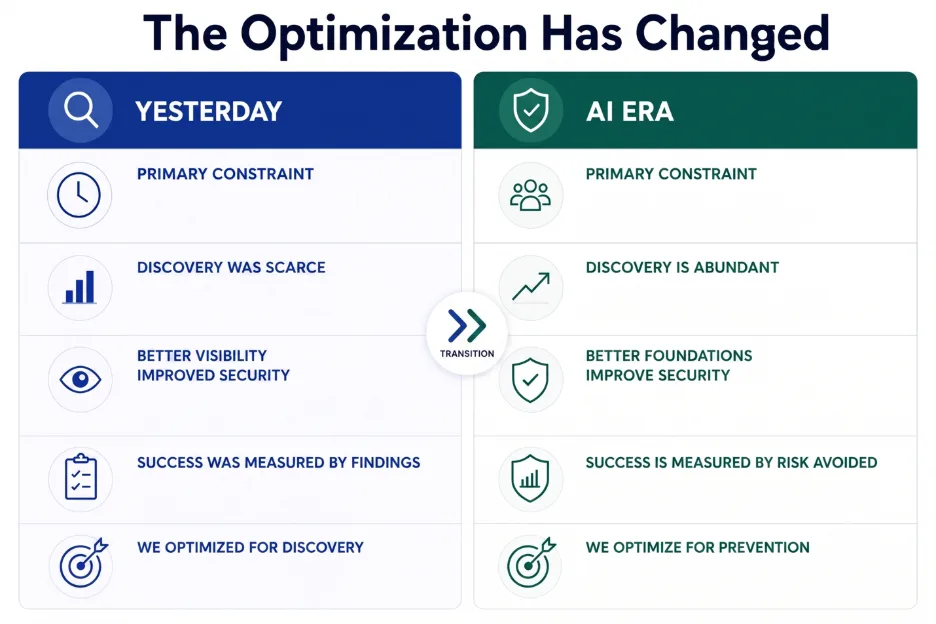
The implications of this shift are already becoming visible across some of the world's most mature software projects.
AI Didn't Create the Problem. It Revealed It.
The recent AI-assisted discovery of long-hidden vulnerabilities in the Linux kernel is a compelling illustration of this shift. Researchers identified vulnerabilities that had remained unnoticed for years, despite Linux being one of the most mature, scrutinized, and widely deployed software projects in the world. These were not obscure applications maintained by small teams. They were flaws within software that powers cloud infrastructure, enterprise systems, embedded devices, and much of the modern internet.
The discoveries naturally raised an uncomfortable question: if vulnerabilities can remain hidden for years in software reviewed by thousands of developers and researchers, what does that say about software security? The answer is surprisingly simple. The Linux kernel did not suddenly become less secure. Those vulnerabilities had existed for years. What changed wasn't the software, but our ability to analyze it. AI-assisted analysis made it possible to examine massive codebases with a speed and consistency that was previously impractical.
Linux is the example, not the story. The real story is what happens when the economics of software analysis change. As the cost of finding vulnerabilities continues to fall, software that once appeared thoroughly understood is being examined through an entirely new lens. Linux is simply the first high-profile example of what is likely to become a much broader industry trend.
Like technical debt, software security debt accumulates over time. Every open-source library, container image, package, binary, and third-party component an organization adopts becomes part of its inherited security risk. Most of those decisions are reasonable when they're made. But over time, they accumulate into a growing backlog of vulnerabilities, outdated dependencies, and unverifiable software that organizations eventually have to manage.
For years, much of this software security debt remained invisible because discovering it required significant time and expertise. AI is changing that equation. By making software analysis dramatically more scalable, it is exposing years of accumulated software security debt faster than organizations can realistically remediate it.
The Discovery Paradox
Artificial intelligence is making vulnerability discovery dramatically cheaper. Engineering capacity is not.
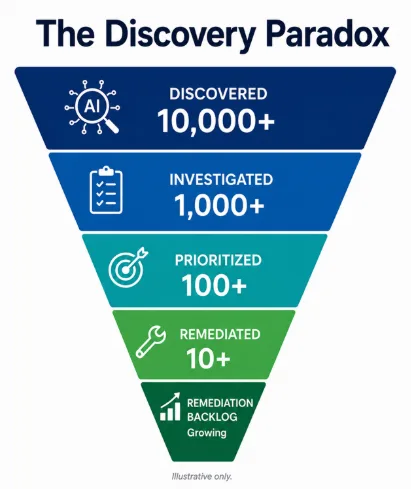
As AI analyzes software at unprecedented speed and scale, organizations can discover far more vulnerabilities than they can realistically investigate, prioritize, and remediate.
AI has shifted the primary bottleneck from discovering vulnerabilities to remediating them and preventing new ones from entering the software supply chain.
Every newly discovered vulnerability still competes for the same engineering time, release cycles, testing effort, and remediation budgets. AI can dramatically accelerate software analysis, but it cannot proportionally increase the number of engineers available to investigate, prioritize, validate, and fix every issue it uncovers.
Finding ten times more vulnerabilities does not make software ten times more secure. It often means organizations inherit ten times more remediation work than they previously knew existed. Visibility improves. Security outcomes do not necessarily improve.
It also exposes a limitation in how software security has traditionally measured success. Metrics such as vulnerabilities discovered, scan coverage, and analysis frequency indicate how effectively organizations identify risk. They reveal very little about whether overall risk is actually decreasing.
Discovery is becoming abundant. Engineering attention is not.
As AI continues to reduce the cost of software analysis, the organizations that gain the greatest advantage will not necessarily be those that discover the most vulnerabilities. They will be those that systematically reduce the amount of avoidable software security debt entering their software supply chains, allowing engineering teams to focus on genuinely new threats instead of an ever-growing backlog of inherited vulnerabilities.
The future of software security cannot be measured solely by how effectively we discover problems. It must also be measured by how effectively we prevent those problems from entering our software in the first place.
The Next Competitive Advantage Is Prevention
If AI is making vulnerability discovery increasingly abundant, organizations need to rethink what defines an effective software security strategy. For years, competitive advantage came from discovering vulnerabilities earlier, scanning more assets, and improving visibility. Those capabilities remain essential, but they are no longer enough.
The next competitive advantage lies in preventing avoidable risk from entering the software supply chain in the first place.
That requires a fundamental shift in thinking. Instead of asking, "How quickly can we discover vulnerabilities after software has been built?" organizations must increasingly ask, "How can we prevent unnecessary vulnerabilities from becoming part of the software we build?"
Every software artifact an organization consumes, whether a container image, open-source library, package, or binary, becomes part of its future security posture. If those artifacts contain known vulnerabilities, unverifiable provenance, outdated dependencies, or unnecessary software, they become tomorrow's remediation backlog. AI may help identify that backlog faster, but it does nothing to reduce the rate at which it is created.
The organizations that succeed will pay as much attention to the software they consume as the software they write. That means choosing verified software artifacts, understanding software provenance, establishing governance, and minimizing inherited risk before development even begins. Every vulnerability that never enters the software supply chain is one less vulnerability to discover, prioritize, and remediate later.
This is where Software Supply Chain Posture becomes a strategic advantage. Organizations with strong Software Supply Chain Posture understand, verify, govern, and continuously improve the software artifacts they build, acquire, and deploy. Instead of managing an ever-growing backlog of inherited vulnerabilities, they reduce the amount of avoidable risk entering their environments in the first place.
AI hasn't made Software Supply Chain Posture optional. It has made it essential.
Conclusion
For years, software security has focused on one primary objective: finding vulnerabilities faster. That approach shaped the tools we built, the metrics we tracked, and the way we measured success. It was the right strategy for a world where discovering vulnerabilities was the hardest problem to solve.
Artificial intelligence is changing that world.
As software analysis becomes faster, cheaper, and more scalable, discovering vulnerabilities is no longer the primary constraint. The challenge is reducing the amount of avoidable risk that enters the software supply chain in the first place. Organizations that continue to optimize for discovery will find themselves managing increasingly larger remediation backlogs. Those that optimize for prevention will spend less time reacting to inherited risk and more time building secure software.
The Linux discoveries are not an isolated event. They are an early signal of what happens when the economics of software analysis fundamentally change. As AI continues to reshape software security, the industry's biggest question is no longer, "How do we find more vulnerabilities?" It's "How do we build software that introduces fewer of them?"
The future of software security won't be defined by who discovers the most vulnerabilities. It will be defined by who introduces the fewest.