


A security scanner flags a critical vulnerability in a software component an application depends on. A fix is available, but only in a newer version of that component.
Upgrading may seem straightforward, but the change can affect APIs, dependencies, application behavior and compatibility with other components. Engineering teams must rebuild, retest and validate the application before deploying the upgrade. That process can take weeks, leaving the vulnerability exposed in production.
Backporting offers another approach. It allows engineers to address a vulnerability in the software version already in use, without requiring an immediate application migration.
What backporting means
Backporting is the process of taking a security fix developed for a newer software version and adapting it to an earlier version that is still in use.
The challenge is that the older version may have a different code structure, dependencies or internal implementation. A security fix written for a newer release may not apply directly. Engineers must understand the original vulnerability, identify the code changes that address it and adapt those changes to the older codebase without introducing unintended behavior.
The process typically involves:
- Identify the security fix: Trace the vulnerability to the code change that addresses it in the newer software version, preferably using a fix published by the original maintainers.
- Adapt the patch: Apply the relevant code changes to the older version, accounting for differences in its source code and dependencies.
- Rebuild the component: Compile and package the modified source into a new software artifact while retaining the intended upstream version.
- Validate the fix: Test that the vulnerability is addressed and that the changes do not introduce regressions or break existing functionality.
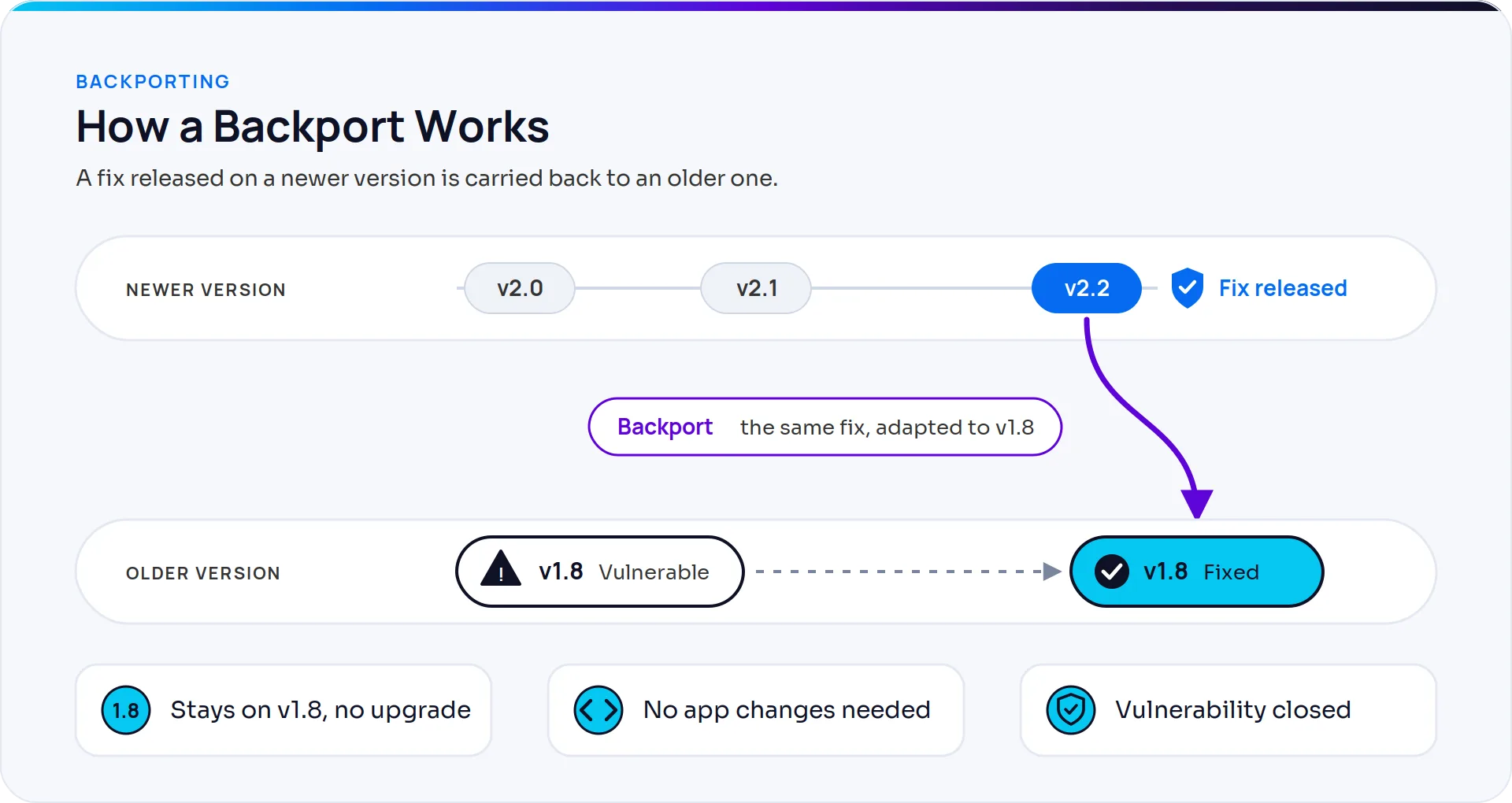
Backporting is a well-established practice in enterprise software maintenance. Enterprise Linux distributions, for example, regularly backport security fixes to older package versions. This allows organizations to receive security updates without having to move immediately to a newer upstream release.
The result is a patched software package that retains its existing upstream version while incorporating a specific security fix.
When you need a backport
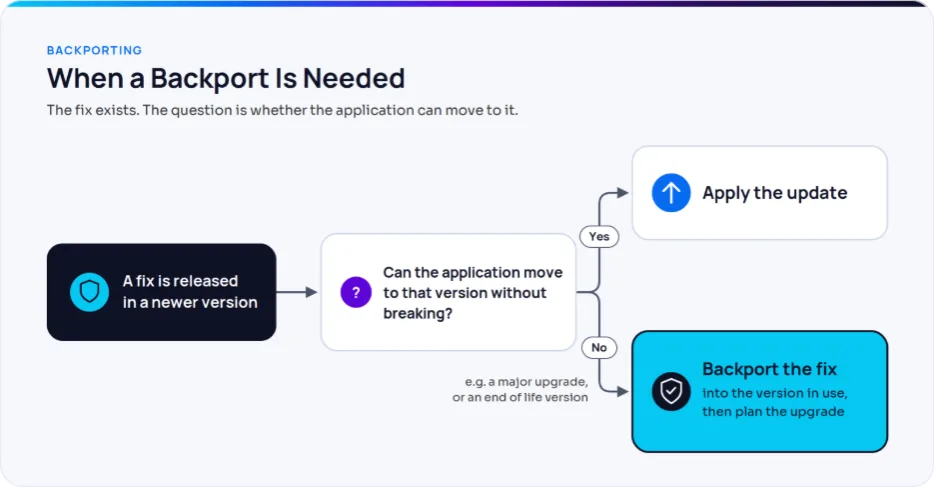
Upgrading to a fixed, supported software version is generally the preferred way to address a vulnerability. But in production environments, that isn't always immediately practical. Two situations make backporting particularly useful.
1. Your software version no longer receives security updates
Open source projects typically maintain a defined set of supported versions. Once a release reaches end of life (EOL), maintainers generally stop publishing security fixes for it. When a new vulnerability is discovered, organizations still running that version may have no upstream security release to apply.
This creates a gap between vulnerability disclosure and remediation. A security backport can address the specific vulnerability in the older codebase, even when the upstream project no longer maintains that release. This may require a vendor or specialist engineering team to source, adapt and validate the fix.
2. Upgrading introduces significant compatibility risks
Sometimes a security fix is available, but only in a newer major release. Moving to that version can involve API changes, dependency updates, framework migrations and application-level modifications.
For production applications, this is not simply a package update. Teams must assess compatibility, modify code where necessary, run regression tests and validate the application before deployment. Depending on the complexity of the application, this can take weeks or months.
Backporting offers a way to address the specific vulnerability while giving teams time to plan and execute the broader upgrade. It reduces the pressure to combine urgent security remediation with a potentially disruptive application migration.
What to look for in a backport
A backport changes the software running in production. Applying a patch is only one part of the process. Organizations need confidence that the fix addresses the vulnerability, preserves application functionality and can be independently verified.
Five questions can help evaluate whether a backport meets that standard.
1. Where did the fix come from?
Start with the origin of the security fix. Ideally, the backport should use the patch developed by the software's original maintainers. This provides a traceable connection to the people who understand the codebase and the vulnerability.
If a third party develops its own fix, the implementation should be supported by a clear technical explanation and evidence that it addresses the underlying vulnerability.
2. Has the patch been properly validated?
A patch that applies cleanly does not automatically mean the vulnerability is fixed. The modified code should be tested against the original vulnerability to confirm that the exploit path is addressed.
Testing should also cover relevant functionality and regression scenarios to identify unintended changes. This is particularly important when adapting a fix to an older codebase, where differences in implementation can affect how the patch behaves.
3. Can the build be reproduced and verified?
Applying the same patch consistently is important, but the build process matters just as much. Reproducible builds allow independent builds from the same source inputs and build instructions to be compared.
When builds produce identical outputs, teams gain stronger assurance that the tested artifact corresponds to the source and build process that were intended for deployment.
4. Can security tools recognize the fix?
A backport often retains the original upstream version number, even though the package contains a security fix. As a result, scanners that rely only on version comparisons may continue reporting the vulnerability.
The fix should be documented in machine-readable security advisories and package metadata, including the relevant CVE identifiers and fixed package information. This allows scanners that consume these records to distinguish patched packages from vulnerable ones.
5. Is the scope of the fix clearly documented?
A backport should identify exactly which CVEs it addresses, which software versions and packages contain the fix, and any relevant behavioral or compatibility changes.
This information helps security teams validate remediation, developers understand what changed, and auditors trace the relationship between a reported vulnerability and the package that addresses it.
A reliable backport is more than a patch applied to an older version. It is a security fix with a traceable origin, validated behavior, verifiable build outputs and clear remediation records.
Backporting at CleanStart
Keeping production software secure doesn't always mean moving to the latest version. For organizations running legacy applications or managing complex dependencies, an immediate upgrade may introduce more risk and disruption than the vulnerability remediation itself.
CleanStart's engineers backport security fixes into existing software versions, allowing customers to address specific vulnerabilities without immediately migrating their applications to newer releases.
Our engineers work from upstream security fixes wherever available, adapt them to the target source version and rebuild the affected packages through controlled build processes. Each remediation is linked to the CVEs it addresses, providing visibility into the security changes incorporated into the resulting package.
Two recent examples demonstrate how this approach works across different software ecosystems.
PHP2Shell: Backporting two critical fixes to PHP 7.4
On October 21, 2026, PHP disclosed two critical vulnerabilities, CVE-2026-109618 and CVE-2026-109619, collectively referred to as PHP2Shell. Both vulnerabilities could allow remote attackers to execute arbitrary code on affected PHP servers without authentication. Each received a CVSS v4.0 score of 9.2.
Why upgrading wasn't a straightforward option.
PHP released security fixes in versions PHP 8.2.35, 8.3.36, 8.4.27 and 8.5.12. PHP 7.4, however, had reached end of life on November 28, 2022, and was no longer receiving official security releases.
For organizations still running PHP 7.4, moving to a fixed version meant migrating to PHP 8. That could involve application compatibility checks, dependency updates and extensive regression testing, while two critical vulnerabilities remained unaddressed.
How CleanStart backported the fixes
The PHP developers had published a minimal security patch for PHP 7.4 on a separate branch. Rather than developing an independent workaround, CleanStart's engineers used this upstream patch as the basis for remediation.
The engineers incorporated the patch into the PHP 7.4.33 source and rebuilt the package with the security changes. The patch was applied as a checksummed file, helping ensure that the intended source changes were consistently applied during the build process.
Both CVEs were also recorded in the package's security fix records, making the remediation traceable to the specific vulnerabilities addressed.
The result was a PHP 7.4.33 package containing the upstream security backport for both CVEs, allowing customers to address these vulnerabilities without immediately migrating their applications to PHP 8.
Spring Framework vulnerabilities addressed in Spring Boot images
Spring Boot applications rely on the Spring Framework and other shared libraries to provide core application functionality. When a vulnerability affects one of these dependencies, every application image containing an affected version may be exposed.
Upgrading Spring Boot to address a vulnerable dependency isn't always straightforward. Applications may depend on specific framework versions, APIs or transitive dependencies, making a broader upgrade difficult to validate and deploy.
CleanStart has addressed nine Spring Framework CVEs in its Spring Boot images:
CVE-2026-47890, CVE-2026-47891, CVE-2026-47893, CVE-2026-59280, CVE-2026-59281, CVE-2026-59282, CVE-2026-59283, CVE-2026-59313 and CVE-2026-59314.
By addressing vulnerabilities in the affected framework components, CleanStart can remediate shared dependencies without necessarily requiring every application to undergo a full Spring Boot migration.
The approach helps reduce the remediation burden across applications that use the same vulnerable components, while maintaining visibility into the specific CVEs addressed.
Backporting is more than applying a patch
Backporting provides a practical way to address security vulnerabilities without forcing immediate application upgrades. But applying a patch is only part of the process. The fix must be correctly adapted, validated, reproducibly built and documented.
For organizations running production workloads, that distinction matters. Security remediation should not just close a vulnerability. It should provide evidence that the software running in production contains the intended fix.