



Chasing zero critical CVEs in container security sounds ideal, but it often misleads teams into overlooking real risks. Container environments demand metrics beyond static vulnerability counts, over 50,000 CVEs expected in 2026 alone, to truly reduce attack surfaces.
The Allure and Pitfalls of Zero CVE Images
Zero CVE images promise pristine scans by minimizing packages to essentials. These distroless or hardened images eliminate hundreds of vulnerabilities from base layers, appealing to compliance-driven teams in Kubernetes ecosystems. However, experts warn that this metric creates a deceptive compliance checkbox and ignores shared kernel risks, where a single host vulnerability can compromise entire clusters. For instance, Linux kernel CVEs have surged since it became its own CVE Numbering Authority (CNA), exposing all containers regardless of image purity. Discussions in DevOps communities highlight how even recent Debian images carry 20+ CVEs, yet zero-CVE pursuits lead to developer burnout without proportional security gains.
Rise of Zero Critical CVEs Goal
Security teams increasingly target zero critical CVEs as a key performance indicator for container deployments. This metric gained traction for tools that promise clean scans, appealing to compliance needs in Kubernetes clusters where base images average over 1,000 CVEs.
Real-world adoption shows mixed results, while 54% of Kubernetes clusters now run supported versions, up from 42% last year, Zero-CVE mandates often force frequent rebuilds that introduce supply chain risks. Base images from distros like Debian often ship with dozens of CVEs, even recent ones. H1 2025 saw 21,500 CVEs disclosed, pushing organizations toward "distroless" or minimal images. Companies bring to market zero-CVE images by stripping unnecessary packages and reducing scan noise.
CleanStart provides signed, minimal images trusted by Fortune 100 companies, reducing vulnerabilities from 200+ to near-zero while cutting false positives from 40% to under 5%. Unlike zero-CVE image vendors that rely primarily on stripping packages, CleanStart achieves low vulnerability counts as an outcome of rebuilding images from trusted source code and producing signed SBOMs.
Standard Debian base images average over 1,000 CVEs, with H1 2025 seeing 21,500 disclosures alone. The Kubernetes Security Report 2025 shows critical vulnerabilities dropped 50% in properly secured pods, while Sysdig 2025 Cloud-Native Security Report reveals 87% of containers still carry high/critical flaws. CleanStart strips these at source.
Yet this focus prioritizes scanner outputs over runtime threats, creating a false sense of security in cloud-native setups.
CVSS Scoring in Container Security
The Common Vulnerability Scoring System (CVSS) v4.0, released in 2023, scores from 0-10 based on exploitability (Attack Vector, Complexity), impact (Confidentiality, Integrity, Availability), and scope. Critical CVEs score 9.0-10.0, triggering alarms in container scanners.
Scanners apply CVSS to packages in layers, flagging base image flaws regardless of application code. CVSS v4.0 adds cloud context but still ignores environmental factors like network isolation. The container vulnerability scanning market reached $954M in 2025 (12.3% CAGR), driven by these flawed signals. CleanStart's SBOM solution provides attested dependency transparency to cut through the noise.
In containers, this leads to uniform scoring across ephemeral workloads, missing nuances of shared kernels or orchestration.
CVSS Lacks Container Runtime Context
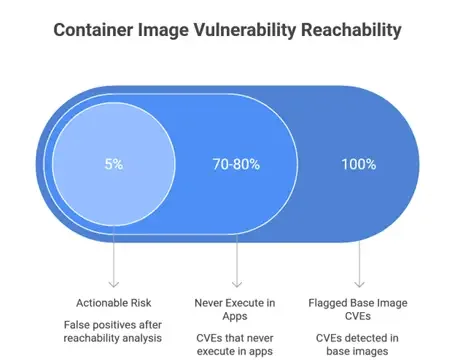
CVSS evaluates flaws in isolation, ignoring runtime details like process execution, network exposure, or proxying in containers. A critical CVE in an unused library, such as an unlinked OpenSSL dependency, scores 9.8 but poses zero risk if unreachable. Studies estimate 70-80% of base image CVEs fall into this dormant category. With CVE disclosures averaging 130+ daily in 2025, temporal scores (factoring patch availability) are outdated within hours. Containers' short lifespans and shared kernels alter CVSS assumptions like Attack Vector (Network vs. Adjacent), amplifying irrelevant alerts. Kubernetes-unique challenges, per ArmoSec analysis, make CVSS subjective; it measures severity, not environment-specific risk. This disconnect diverts focus from active threats in Docker, Podman, or K8s environments.
Presence vs Reachability of Vulnerabilities
Vulnerability presence detects CVEs in images via signature matching; reachability validates exploit paths from attackers. Scanners excel at presence but falter on reachability Mend's research shows reachability cuts noise by prioritizing used packages via static analysis or eBPF runtime profiling. The LUCID framework, though not widely documented, aligns with tools that reduce scanner inconsistencies by 70% through code flow mapping. 70-80% of flagged base CVEs never execute in apps. CleanStart achieves <5% false positives via cryptographic verification.
False Positives from Shared Base Images
Shared base images, such as Alpine or Ubuntu, increase false positives across fleets—one unpatched layer can flag thousands of containers. Version mismatches and scanner database lags can cause up to 70% of alerts to be inconsistent. Prebuilt images typically contain 1,000+ CVEs versus application stacks' 100.
CleanStart reduces false positives by 90% and vulnerability management effort by 85%, enabling same-day deployments rather than 3-week review cycles.
Reddit threads from 2025 echo this: teams with 120-200 CVEs per container push back on zero-mandate policies, advocating risk-assessed prioritization using EPSS and compensating controls such as segmentation.
Clean Dashboard Anti-Pattern Exposed
A pristine vulnerability dashboard feels reassuring but signals the anti-pattern of over-reliance on static scans. It hides unassessed risks, such as configuration drift or zero-days. Development teams burn out chasing 200+ irrelevant CVEs per container while real threats persist.
True security favors risk-aware dashboards over zero counts.
Zero CVEs Reduces Visibility Risks
Extreme minimalism strips debugging and logging tools essential for incident response. Constant rebuilding (required for true zero-CVE) introduces regression risks. Scanner suppression hides legitimate issues amid pervasive false positives.
Pushing for zero CVEs often results in minimal images, stripping logging or debugging tools. This limits incident response visibility. Over-patching introduces regressions, and scanner suppression hides legitimate issues. Reduced package counts mask supply chain flaws.
Balance requires accepting managed risk over blind elimination.
Better Metrics for Container Risk
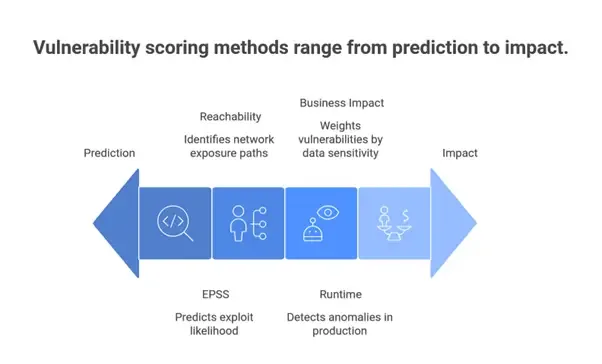
Shift to exploit the prediction scoring system (EPSS) for real-world likelihood, combined with asset criticality.
EPSS (Exploit Prediction Scoring System): Scores above 0.37 predict 50% of real-world exploits.
- Reachability analysis: Cuts noise by 70%.
- Runtime behavioral monitoring: Detects anomalies in production.
- Attack surface area: Quantifies network exposure paths.
- Business impact scoring: Weights vulnerabilities by data sensitivity.
Metric | Key Statistic | Container Benefit |
EPSS | >37.8% covers 50% exploits | Prioritizes active threats |
Reachability | 70% noise reduction | Filters base image clutter |
CVSS Critical | 5-10% of total CVEs | Overflags unreachable flaws |
CVE Projection 2025 | 50,000 total (130+/day) | Unmanageable triage burden |
CleanStart FP Reduction | 90% decrease | Verified, attested images |
Container Attacks | 400% yearly growth | Runtime threats dominate |
Reducing Attack Surface Effectively
Proven strategies:
- Minimize image layers - CleanStart offers 60-80% smaller images.
- Enforce least-privilege with non-root users by default.
- Network segmentation via Kubernetes NetworkPolicies.
- Automate complete SBOMs with VEX attestations.
- Follow CIS Kubernetes Benchmarks for hardening.
Focus on mean time to respond (MTTR) over arbitrary CVE thresholds.
Key Takeaway: Industry reports like Sysdig 2025 Cloud-Native Report and Wiz Kubernetes Security Report 2025 confirm contextual metrics outperform zero-CVE chasing. CleanStart delivers 85% less security toil with FIPS/SLSA compliance
FAQ: Container Security Metrics
What makes zero critical CVEs misleading?
CVSS ignores runtime reachability, 70-80% base CVEs never execute. Real threats need EPSS + behavioral analysis.
What percentage of containers have critical vulnerabilities?
87% per Sysdig 2025; 50% of popular public images affected.
How does CleanStart achieve <5% false positives?
Cryptographic provenance, signed SBOMs, and continuous rebuilds eliminate scanner guesswork.
How to measure actual container risk?
Use reachability, EPSS, and runtime monitoring over static counts.
Are distroless images secure?
They reduce CVEs but rely on host kernels and require broader defences.
Easiest Way to Secure Your Containers:
Pull verified images from CleanStart Images, automate SBOM compliance, and eliminate vulnerability remediation toil. Your custom containers become FIPS-validated, audit-ready, and 60-80% smaller, straight from secured repositories. Share your security concerns, and our experts will ensure they're fully addressed. Get started with CleanStart today!