



The Dawn of AI-Generated Software
The software industry is undergoing its most profound shift since the birth of the internet. AI-powered coding tools have made software creation accessible to almost anyone with an idea and the ability to describe it in natural language. In February 2025, Andrej Karpathy, a founding member of OpenAI, coined the term “vibe coding,” describing a workflow where people explain what they want to build and AI writes, refines, and debugs the code.
Adoption is already widespread. Eighty-two percent of developers now use AI coding assistants daily or weekly, and an estimated 41% of code produced in 2025 is either AI-generated or AI-assisted. The AI code generation market, valued at $4.91 billion in 2024, is projected to reach $30.1 billion by 2032. Meanwhile, low-code and no-code platforms are expected to account for more than 70% of new enterprise applications by 2025.
As AI-generated code becomes ubiquitous, software supply chain security, SBOM transparency, and verifiable provenance are emerging as the real determinants of whether software can be trusted. In a world where features are easily replicated, the foundation beneath the code is what now defines competitive advantage.
For business leaders, this shift raises a simple but uncomfortable question: when the barrier to building software collapses, where does competitive advantage come from?
The Commoditization of Software Features
The democratization of software development creates a classic commoditization paradox. The same tools that accelerate innovation also erode the traditional moats that once protected software businesses.
One analysis found that the median replication time for novel API-driven functionality dropped from 18 months in 2017 to just 2.4 weeks in 2024, a 98% collapse in the half-life of technical advantage. Another observer warns that entire products can now be cloned at scale without large engineering teams or R&D budgets.
This effect is especially visible in specialized domains. Medical professionals with limited technical backgrounds have successfully built diagnostic support tools using no-code AI platforms, achieving documented improvements in diagnostic accuracy of 23% in certain applications. When a cardiologist can assemble a patient monitoring application over a weekend, the software vendor that once sold that capability faces a fundamentally different market reality.
The implication is stark: the competitive advantage of simply having built a product is approaching zero. As one industry analysis notes, your codebase is not a moat, and your UI is not an advantage. Any software that is not truly differentiated will be undercut by cheaper or free alternatives that are good enough for most users.
The Security Risks of AI-Generated Code
This democratization comes with a cost that many organizations are only beginning to confront. The same AI tools that speed up development are introducing security risk at unprecedented scale.
Research from Georgetown University’s Center for Security and Emerging Technology found that roughly 40% of programs generated by AI coding assistants contained vulnerabilities from MITRE’s list of the most dangerous software weaknesses. A separate study showed that 68–73% of AI-generated code samples contained vulnerabilities when manually reviewed. BaxBench testing revealed that 41–62% of AI-generated code contains security issues even with extensive prompting.
The velocity–vulnerability tradeoff is now measurable. By June 2025, AI-generated code was responsible for more than 10,000 new security findings per month across analyzed repositories, a tenfold increase in just six months. While trivial syntax errors dropped and logic bugs fell sharply, privilege escalation paths jumped more than 300%, and architectural design flaws spiked over 150%.
Even more concerning is remediation. Only 21% of serious AI and LLM vulnerabilities are ever fixed, the lowest remediation rate of any category tracked by security researchers. AI applications and LLMs also exhibit the highest proportion of high-risk findings of any asset type tested.
The downstream impact is enormous. The global annual cost of software supply chain attacks reached $60 billion in 2025 and is projected to climb to $138 billion by 2031. Thirty percent of breaches now involve a third party, and more than 75% of organizations experienced a software supply chain attack in the last year.
When everyone can code, everyone inherits the security debt of AI-generated software. The question is no longer whether you can build something. It is whether what you build can be trusted.
New Axes of Differentiation in the AI Era
In this environment, durable competitive advantage shifts to areas that AI cannot easily commoditize trust, compliance, domain expertise, and verifiable security.
Trust as the Ultimate Moat
When functionality becomes fungible, trust becomes the primary differentiator. Users gravitate toward platforms they believe will keep their data and systems safe. In a world where switching costs are low and feature parity is high, perceived security and reliability become anchors for long-term relationships.
This is especially true in the enterprise. Gartner predicts that by 2025, 45% of organizations worldwide will have experienced attacks on their software supply chains. The ability to demonstrate provable security is quickly becoming a competitive weapon.
Compliance as Competitive Advantage
Regulatory frameworks are increasingly explicit about software supply chain transparency. Executive Order 14028 requires federal contractors to implement secure development practices, generate SBOMs, and cryptographically sign artifacts, while guidance from National Institute of Standards and Technology (NIST) and Cybersecurity and Infrastructure Security Agency (CISA) further defines expectations for secure software development and SBOM adoption. The EU Cyber Resilience Act introduces similar expectations around transparency and attestation.
Organizations that embed compliance into their foundations, rather than bolting it on later, gain structural advantages in regulated markets such as government, healthcare, and financial services.
Domain Expertise Over Feature Parity
True differentiation is not about having different features. It is about solving different problems or solving the same problems in fundamentally different ways.
When AI can reproduce almost any feature, the real value lies in knowing which problems are worth solving and how to solve them well. Deep domain expertise, built over years of working with customers, becomes a defensible asset.
Network Effects and Data Moats
The companies most likely to endure are those that build proprietary data assets and network effects that cannot be recreated through AI-generated code alone. A product may be easy to clone, but decades of customer implementations, integrations, and operational knowledge create switching costs that transcend the software itself.
Building on Verified Software Supply Chain Foundations
A key insight emerges from this shift: when everyone can create software, differentiation moves beneath the application layer and into the infrastructure itself.
Organizations using AI to rapidly prototype applications face a choice. They can build on commodity infrastructure that may contain vulnerabilities throughout the supply chain, or they can build on foundations where security and integrity are verifiable at every layer.
CleanStart addresses this by embedding security at the deepest infrastructure level within CleanStart OS, enabling verifiable-by-design foundations andhardened compliant container images. Instead of retrofitting controls onto commodity containers, CleanStart establishes verifiable foundations from the first line of code. This includes:
- Supply chain integrity with every component traceable to verified sources and cryptographic provenance
- SLSA Level 3/4 compliance with hermetic builds and comprehensive provenance as defined by the OpenSSF.
- Cryptographically signed, complete SBOMs
- Daily security updates through automated build pipelines
This approach turns security from a reactive activity into a built-in property. When organizations deploy AI-generated applications on verified foundations, they inherit trust rather than technical debt.
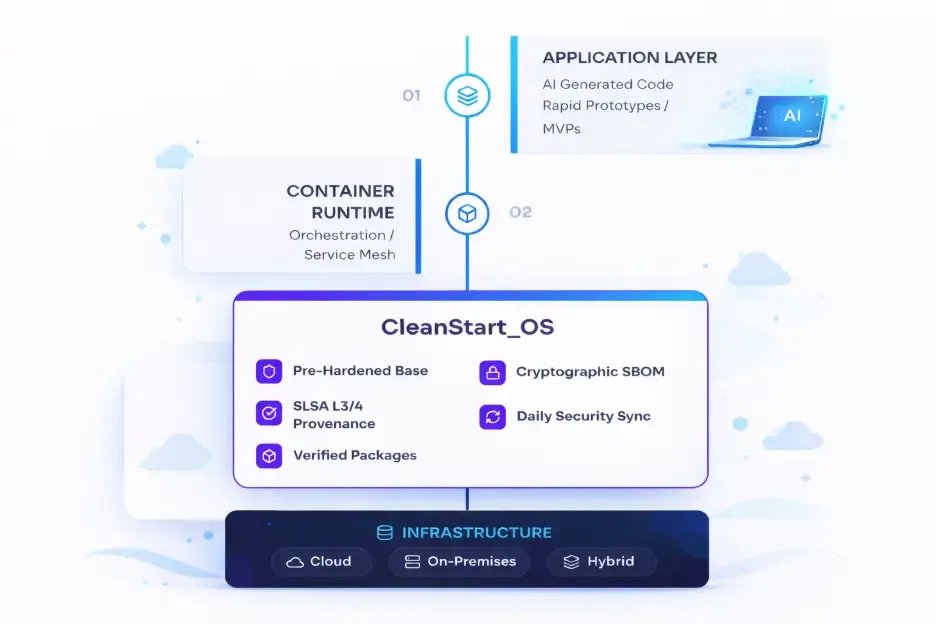
Figure 1: Verifiable-by-design foundations shift differentiation below the application layer, enabling AI-generated software to run on trusted, compliant infrastructure.
Frequently Asked Questions
What is software supply chain security?
Software supply chain security ensures that every component, dependency, and build artifact can be traced, verified, and trusted from source to deployment, reducing the risk of hidden vulnerabilities and tampering.
Why is AI-generated code risky?
AI-generated code often inherits insecure patterns, vulnerable dependencies, and opaque provenance, which makes traditional scanning insufficient for preventing supply chain attacks.
What is a verifiable software foundation?
A verifiable foundation is infrastructure built so that provenance, integrity, and compliance are intrinsic properties, enforced through cryptographic signing, hermetic builds, and complete SBOMs.
How does SBOM improve security?
A Software Bill of Materials provides a complete inventory of components, enabling faster vulnerability response, better risk assessment, and regulatory compliance.
Why is trust becoming the main differentiator in software?
When features are easily replicated by AI, customers choose platforms that can prove security, reliability, and compliance rather than those that simply ship faster.
What is SLSA and why does it matter?
SLSA (Supply-chain Levels for Software Artifacts) defines maturity levels for build integrity and provenance, helping organizations prevent tampering, unauthorized changes, and compromised build pipelines.
The Path Forward: Secure Speed with Verifiable Foundations
The future of software development is not a choice between velocity and security. Sustainable velocity depends on verifiable foundations.
For business leaders, three principles stand out:
First, embrace democratization. AI coding tools deliver real productivity gains. The question is not whether to use them, but how to use them safely.
Second, recognize the new attack surface. Every AI-generated function, dependency, and container image introduces potential risk.
Third, build on verified foundations. As the application layer becomes commoditized, competitive advantage shifts to infrastructure that can prove security, compliance, and integrity.
The democratization of software development is accelerating. The organizations that thrive will be those that recognize early that trust, not features, is the ultimate differentiator, and build their software foundations accordingly.
Biswajit De
Co-founder & Chief Technology Officer at CleanStart, leading development of verifiable-by-design infrastructure and hardened operating systems for secure software supply chains.