


Modern software is rarely built entirely from scratch.
Every application depends on external code, build tools, container images, package repositories, CI/CD systems, cloud infrastructure, and deployment pipelines. Even a relatively simple application may rely on hundreds or thousands of upstream components maintained by external contributors.
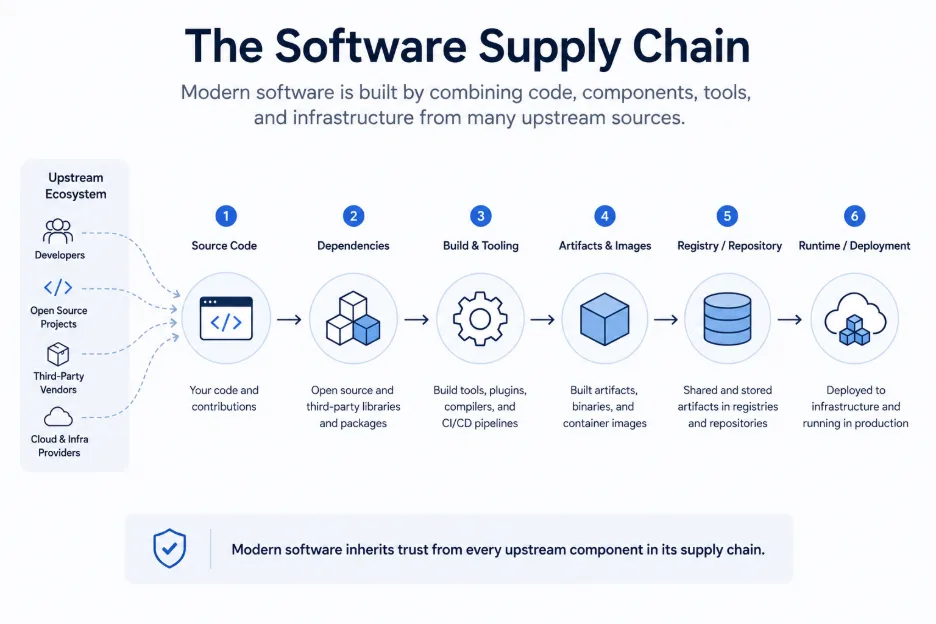
This interconnected ecosystem is known as the software supply chain.
Just as physical supply chains move raw materials through manufacturing and distribution before a product reaches customers, software supply chains move code through multiple stages before software reaches production.
The challenge is that every stage introduces trust dependencies.
If any component in the chain is compromised, vulnerable, tampered with, or misconfigured, that risk can propagate downstream into enterprise environments.
This is why software supply chain security has become one of the most important priorities in modern cybersecurity.
The Origins of Software Supply Chain Security
The concept of software supply chain security is not entirely new, but it became significantly more important as software development shifted toward open source reuse, distributed development, and cloud-native delivery.
Historically, software was often developed internally with relatively limited external dependencies.
That model changed dramatically with the rise of:
- Open-source ecosystems
- Internet-scale package repositories
- DevOps automation
- CI/CD pipelines
- Containers and Kubernetes
- Cloud-native architectures
As software assembly became more modular, organizations increasingly relied on upstream components maintained outside their direct control.
Several major incidents helped establish software supply chain security as a critical cybersecurity discipline.
Early Dependency and Package Ecosystem Risks
In the 2010s, organizations began recognizing how heavily modern applications depended on public package ecosystems such as npm, PyPI, Maven, and RubyGems.
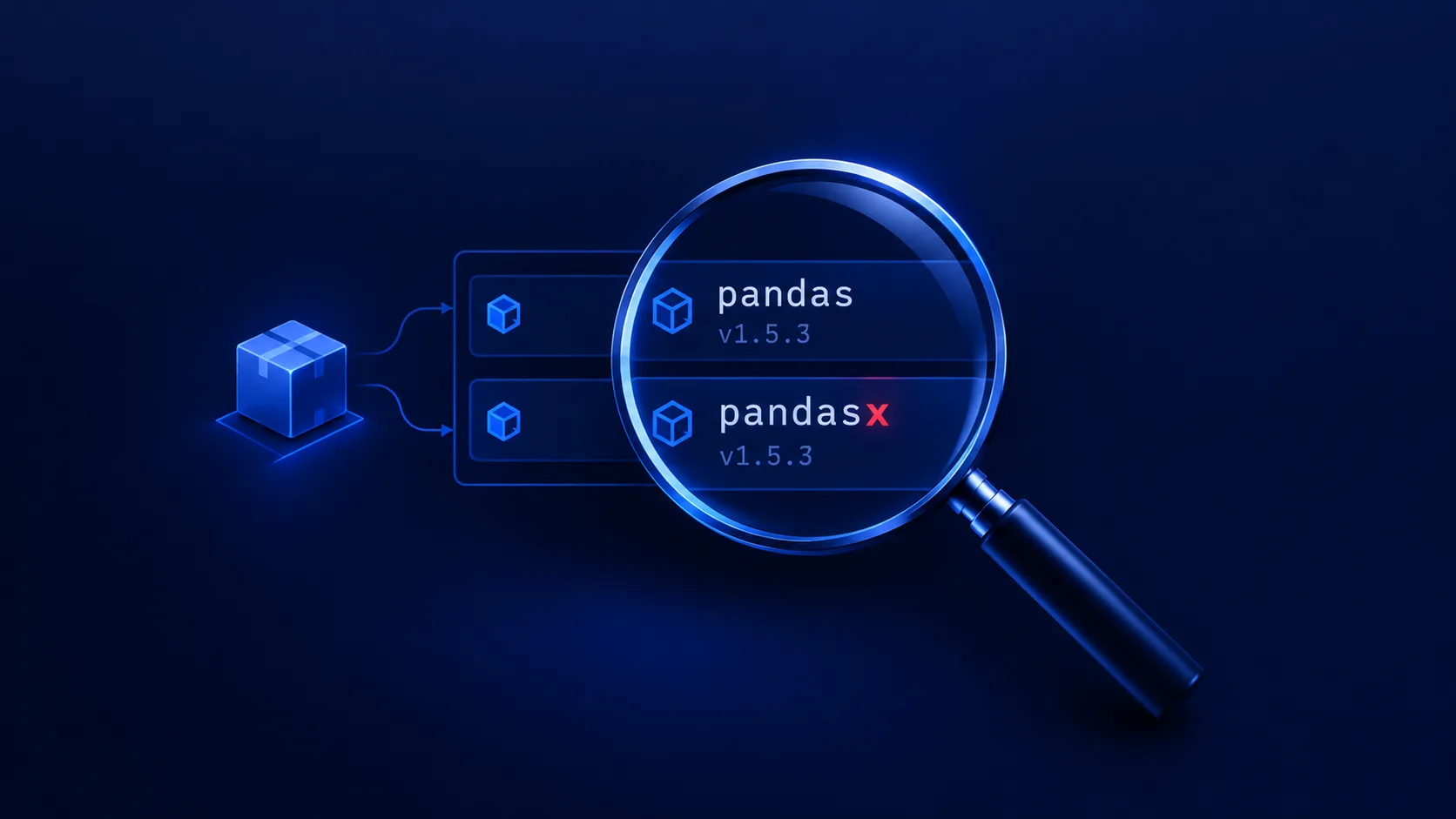
Incidents involving typo-squatting, malicious packages, abandoned dependencies, and account takeovers demonstrated that attackers could compromise large numbers of downstream applications by targeting upstream ecosystems.
NotPetya and Software Distribution Abuse
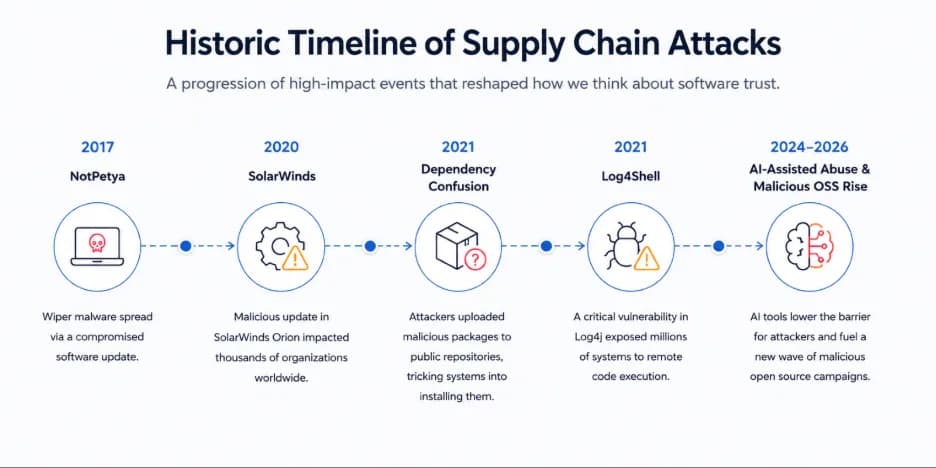
The 2017 NotPetya attack highlighted how trusted software distribution channels could be weaponized.
Attackers compromised a Ukrainian accounting software update mechanism, allowing malware to propagate through legitimate software updates into global enterprise environments.
This demonstrated that trusted software delivery channels themselves could become attack vectors.
Solar Winds and Build Pipeline Compromise
The 2020 SolarWinds compromise became one of the defining software supply chain attacks.
Attackers infiltrated the software build environment and inserted malicious code into signed software updates distributed to thousands of organizations.
The incident fundamentally changed how enterprises and governments viewed software trust.
It reinforced several key realities:
- Signed software is not automatically trustworthy
- Build environments are high-value targets
- Software provenance matters
- Trust assumptions inside CI/CD systems can be exploited
- Downstream customers inherit upstream risk
Log4Shell and Transitive Dependency Risk
The Log4j vulnerability in 2021 further emphasized the scale of modern software dependency risk.
Many organizations struggled to identify whether vulnerable Log4j components existed inside their applications, containers, and transitive dependencies.
This highlighted the importance of:
- Dependency visibility
- SBOM generation
- Software inventory management
- Continuous supply chain monitoring
Government and Industry Response
In response to growing supply chain attacks, governments and industry groups accelerated initiatives focused on software integrity.
This included initiatives such as Executive Order 14028 in the United States, increased SBOM adoption, the NIST Secure Software Development Framework (SSDF), development of the SLSA framework, and growing emphasis on reproducible builds and provenance validation.
Today, software supply chain security is viewed as a foundational security discipline across modern software engineering.
Why Software Supply Chains Matter
Software development has fundamentally changed.
Organizations today build applications faster than ever by assembling existing components rather than writing everything internally. Development teams pull packages from public repositories, deploy prebuilt container images, integrate third-party APIs, and automate releases through CI/CD pipelines.
This dramatically improves development velocity.
But it also expands the attack surface.
Many organizations no longer have full visibility into:
- Which components are running in production
- Where those components originated
- Whether the code was modified during the build process
- Whether dependencies contain known vulnerabilities
- Whether build environments were compromised
- Whether container images can be trusted
As software ecosystems become more interconnected, attackers increasingly target the supply chain itself rather than attacking applications directly.
Instead of breaching one organization at a time, attackers compromise shared dependencies, package repositories, build systems, or widely used components to impact many downstream users simultaneously.
This is what makes supply chain attacks uniquely dangerous.
What Makes Up a Software Supply Chain?
A software supply chain includes every component, system, and process involved in building and delivering software.
This typically includes source code repositories, open source dependencies, package managers, CI/CD systems, container images, artifact registries, and deployment infrastructure.
Each of these layers introduces its own trust assumptions and security risks.
Source Code
Applications often combine internally developed code with open source libraries, third-party SDKs, shared internal components, and external APIs.
This modular development model accelerates innovation, but it also means organizations increasingly inherit risk from external ecosystems they do not directly control.
Dependencies and Package Managers
Developers rely heavily on package ecosystems such as npm, PyPI, Maven, NuGet, RubyGems, and Go modules.
These ecosystems dramatically simplify software development by enabling rapid reuse of existing functionality. However, they also create concentrated trust dependencies.
A single vulnerable or malicious package can impact thousands of downstream applications across many organizations.
Build Systems and CI/CD Pipelines
Modern software delivery depends on automated pipelines.
CI/CD systems compile code, resolve dependencies, run tests, build container images, and deploy applications automatically.
If attackers compromise build pipelines, they can inject malicious code directly into trusted software artifacts.
Container Images
Containers have become foundational to modern application delivery.
But most container images are assembled from multiple upstream layers, operating system packages, runtime libraries, and third-party dependencies.
This means container risk is often inherited rather than introduced directly by developers.
A vulnerable base image can silently propagate risk across hundreds of workloads.
Artifact Repositories and Registries
Built software artifacts are typically stored in:
- Container registries
- Artifact repositories
- Internal package registries
- Binary distribution systems
These systems become critical trust points in the software delivery lifecycle.
Deployment Infrastructure
The software supply chain extends into runtime environments as well, including:
- Kubernetes clusters
- Cloud infrastructure
- Virtual machines
- Serverless platforms
- Edge systems
Compromised deployment systems can distribute malicious or altered software at scale.
How Software Supply Chain Attacks Work
Software supply chain attacks target trusted relationships inside the software delivery process.
Instead of directly attacking end users, adversaries compromise upstream components that downstream organizations already trust.
Common attack paths include:
Compromised Open-Source Packages
Attackers may:
- Publish malicious packages
- Hijack abandoned projects
- Inject malware into popular dependencies
- Use typo-squatting techniques to trick developers
Once developers install these packages, malicious code enters build environments and production systems.
Compromised Build Pipelines
If attackers gain access to CI/CD systems, they may:
- Modify source code during builds
- Inject malicious binaries
- Steal signing keys
- Alter deployment artifacts
- Manipulate software releases
Because the resulting software appears legitimate, these compromises are difficult to detect.
Malicious or Vulnerable Container Images
Organizations frequently pull container images from public registries without fully verifying their origin or integrity.
Attackers may distribute:
- Backdoored images
- Images containing malware
- Images with embedded secrets
- Vulnerable images with known CVEs
Once deployed, these images become part of the production environment.
Dependency Confusion Attacks
Dependency confusion occurs when internal package names are accidentally resolved from public repositories.
Attackers publish malicious packages using the same names as internal dependencies, causing build systems to pull untrusted code.
This attack category demonstrated how default trust assumptions in package resolution mechanisms could be exploited at scale.
It also reinforced that software supply chain security is not limited to vulnerabilities alone. Repository configuration, dependency governance, and build isolation are equally important.
Dependency Hijacking and Maintainer Risk
Modern open source ecosystems often rely on small groups of maintainers supporting widely used projects.
Attackers increasingly target maintainer accounts, CI tokens, publishing credentials, abandoned projects, and under-maintained dependencies.
This creates systemic risk because compromise of a single upstream project can cascade into thousands of downstream environments.
As a result, organizations need visibility not only into vulnerabilities, but also into dependency trustworthiness, maintainer health, and software provenance.
Transitive Dependencies and Hidden Risk
One of the most difficult software supply chain challenges is transitive dependency sprawl.
Applications often depend on libraries that themselves depend on many additional upstream packages.
As a result, developers may indirectly inherit hundreds or thousands of components they never explicitly selected.
This creates hidden layers of risk that are often difficult for security teams to track.
Organizations may unknowingly inherit vulnerable or malicious packages through multiple layers of indirect dependencies. These transitive chains also make remediation significantly more complex because updating one component can affect many interconnected packages.
The Log4Shell incident demonstrated how difficult it can be for organizations to quickly determine whether deeply nested dependencies exist inside their environments.
This is why modern software supply chain security increasingly prioritizes:
- Dependency inventory accuracy
- Continuous SBOM generation
- Provenance tracking
- Minimal software composition
- Build reproducibility
Beyond dependency and build compromise, attackers may also target the trust mechanisms used to validate software integrity itself.
Compromised Code Signing or Trust Infrastructure
Signed software is only trustworthy if the signing and provenance infrastructure itself remains secure.
Compromised trust infrastructure can undermine even cryptographically signed software artifacts.
Attackers may also target:
- Signing certificates
- Trust stores
- Build provenance systems
- Artifact integrity controls
If trust mechanisms themselves are compromised, organizations may unknowingly deploy tampered software.
Why Traditional Security Approaches Struggle
Traditional security models were not designed for modern software supply chains.
Historically, organizations focused primarily on perimeter security and runtime security.
But software supply chain security introduces different challenges:
Scale
Modern applications may contain:
- Thousands of dependencies
- Multiple programming languages
- Rapid release cycles
- Constant upstream updates
Manually tracking software provenance becomes nearly impossible.
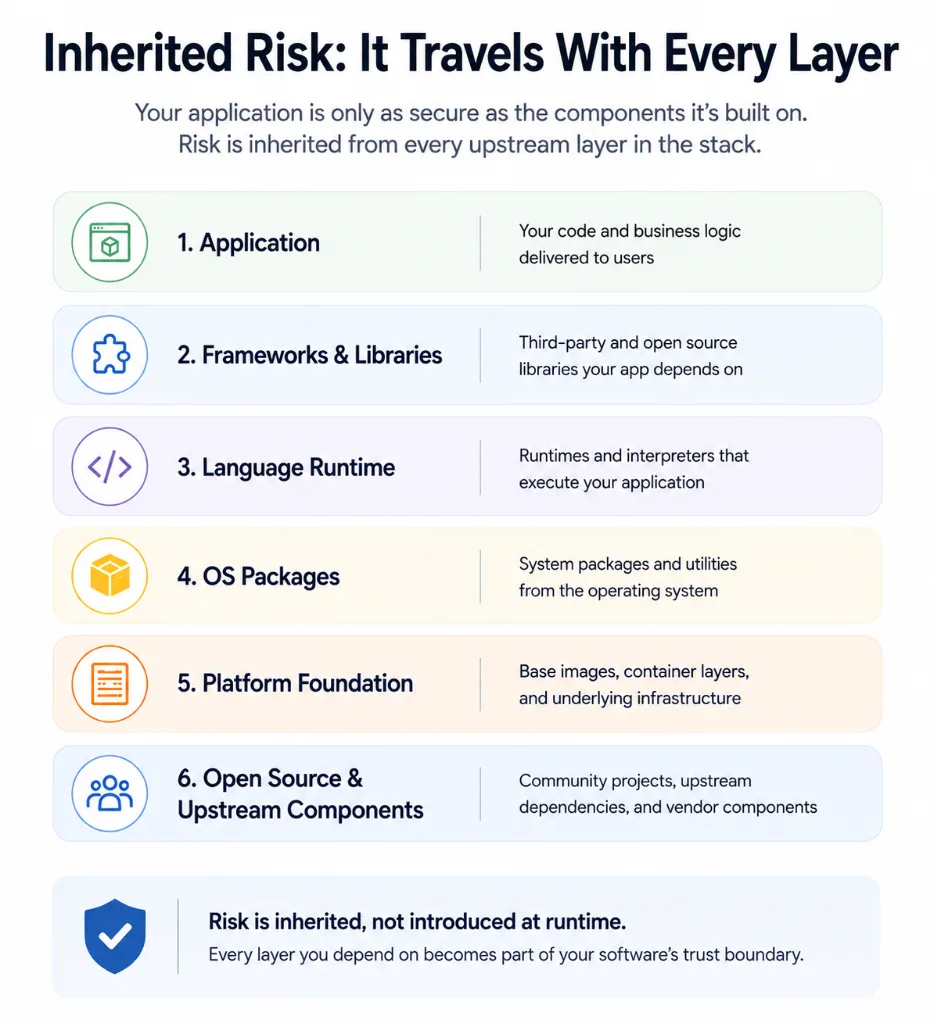
Inherited Risk
Most organizations do not directly create the majority of the software components they use.
Risk is inherited from:
- Open source maintainers
- Base image publishers
- External package repositories
- Third-party vendors
- Build environments
This means organizations often deploy software they did not fully build or verify themselves.
Lack of Provenance
Many organizations cannot confidently answer:
- Where did this software originate?
- Who built it?
- What dependencies were included?
- Was the build process tampered with?
- Can the artifact be reproduced?
Without provenance, trust becomes assumption-based.
Vulnerability Noise
Security teams often rely heavily on vulnerability scanning.
While scanning is important, it does not establish software trust.
A container image with fewer CVEs is not automatically trustworthy.
Similarly, a fully patched image may still contain:
- Malicious code
- Unknown vulnerabilities
- Unsafe build processes
- Tampered dependencies
- Weak provenance controls
This is why modern software supply chain security focuses increasingly on trust, integrity, and verifiability rather than vulnerability counts alone.
Key Concepts in Software Supply Chain Security
Software Bill of Materials (SBOM)
An SBOM is an inventory of software components and dependencies.
It helps organizations understand:
- What software is included in an application
- Which versions are present
- Which dependencies may be vulnerable
- What upstream components are in use
SBOMs improve visibility, but visibility alone does not guarantee trust.
Provenance
Provenance describes how software was built.
This includes:
- Source origins
- Build systems
- Build environments
- Build processes
- Dependency resolution paths
Provenance helps organizations verify whether software artifacts were produced securely.
Reproducible Builds
A reproducible build generates identical outputs when built from the same source under the same conditions.
Reproducibility helps verify that artifacts were not altered during the build process.
This significantly improves software integrity and auditability.
Signed Artifacts
Cryptographic signing helps verify that software artifacts have not been modified after creation.
This strengthens integrity validation across the supply chain.
SLSA Framework
Supply-chain Levels for Software Artifacts (SLSA) is a security framework designed to improve software supply chain integrity.
SLSA focuses on improving build security, provenance generation, artifact integrity, tamper resistance, and build environment controls.
Rather than prescribing a single security product or workflow, SLSA provides maturity levels that help organizations progressively strengthen software build and delivery pipelines.
Organizations increasingly use SLSA principles to reduce trust assumptions in CI/CD systems and establish stronger build integrity guarantees.
In-Toto, Sigstore, and Modern Artifact Verification
Modern software supply chain security increasingly depends on verifiable cryptographic trust.
Several emerging technologies are becoming important across cloud-native ecosystems.
In-Toto
In-toto is a framework designed to secure software supply chains by creating attestations across every stage of the software lifecycle.
It helps organizations verify:
- Who performed a build step
- What actions were executed
- Whether artifacts were modified unexpectedly
- Whether required controls were followed
Sigstore and Cosign
Sigstore is an open source project focused on simplifying software signing and verification.
Cosign, one of its most widely adopted components, enables cryptographic signing of container images and software artifacts.
This helps organizations verify artifact authenticity and integrity before deployment.
Transparency Logs
Transparency systems such as Rekor provide tamper-evident logging for software signatures and attestations.
These mechanisms improve auditability and help detect unauthorized modifications or signing abuse.
Together, these technologies are helping move the industry toward verifiable software trust rather than assumption-based trust models.
Why Containers Have Become Central to Supply Chain Security
Containers now sit at the center of modern software delivery.
But container ecosystems inherit risk from multiple upstream layers.
A typical container image may include:
- Linux distribution packages
- Runtime libraries
- Language dependencies
- Application frameworks
- Third-party utilities
- Developer-added components
Many organizations discover that the majority of container vulnerabilities originate from inherited base image content rather than application code.
This creates several challenges:
- Large vulnerability backlogs
- Difficulty patching images quickly
- Excessive CVE noise
- Limited visibility into image provenance
- Unclear trust boundaries
As a result, many organizations are shifting toward minimal, hardened, and verifiable container images designed specifically to reduce inherited risk.
What Security Teams Should Focus On
Software supply chain security is not solved by a single tool.
It requires a combination of visibility, integrity, provenance, and operational discipline.
Key priorities typically include:
Reduce Unnecessary Dependencies
Every dependency expands the attack surface.
Minimizing unused packages and components reduces inherited risk.
Harden Build Pipelines
CI/CD systems should be treated as critical infrastructure.
Organizations should secure:
- Build runners
- Secrets
- Signing systems
- Artifact repositories
- Access controls
- Pipeline permissions
Verify Software Origins
Organizations should understand:
- Where artifacts came from
- Who built them
- Whether builds are reproducible
- Whether provenance can be validated
Strengthen Container Trust
Container security should focus not only on scanning, but also on:
- Minimal images
- Trusted sources
- Reproducible builds
- Verified provenance
- Continuous patching
- Hardened baselines
Continuously Monitor Dependencies
Open source ecosystems change constantly.
Security teams should continuously track:
- New vulnerabilities
- Dependency updates
- Malicious package activity
- Upstream compromise risks
The Future of Software Supply Chain Security
Software supply chain security is rapidly evolving from a niche concern into a foundational cybersecurity discipline.
Several trends are accelerating this shift:
Regulatory Pressure
Governments and regulators increasingly expect organizations to demonstrate software integrity and supply chain visibility.
This includes growing emphasis on:
- SBOM requirements
- Secure software development practices
- Provenance validation
- Vendor risk management
- Secure-by-design principles
Increased Open Source Dependency
Modern development ecosystems will continue relying heavily on open source software.
This makes upstream trust and dependency security increasingly important.
Shift Toward Verifiable Software
Organizations are moving beyond simple vulnerability management toward verifiable trust models.
This includes:
- Reproducible builds
- Signed artifacts
- Provenance attestations
- Hermetic build systems
- Zero trust software pipelines
Security Earlier in the Lifecycle
Software supply chain security is becoming a build-time priority rather than only a runtime concern.
The earlier integrity and trust can be established, the lower the downstream operational risk.
Final Thoughts
Modern software is assembled, not simply written.
Every application depends on a complex ecosystem of external components, build systems, dependencies, container images, and delivery pipelines.
That ecosystem is the software supply chain.
As organizations accelerate software delivery, attackers increasingly target the trust relationships inside that chain.
This is why software supply chain security is no longer optional.
Security teams need visibility into what they deploy, confidence in where software originated, and assurance that artifacts were built securely and have not been tampered with.
The future of software security is increasingly centered on verifiable trust.
And software supply chain security is becoming the foundation that enables it.