


Modern software supply chain attacks have moved past CI/CD pipelines and production environments. Attackers now target software consumed during development, because a single compromised artifact can spread downstream into thousands of organizations.
The compromise of the Nx Console Visual Studio Code extension on May 18, 2026 shows how this works. At first glance it looked like another malicious extension incident. A closer look reveals something more significant.
The attack exploited no vulnerability in Visual Studio Code, Microsoft's marketplace, or the extension itself. It exploited something harder to patch: the implicit trust developers place in the software they consume every day. It targeted a boundary few organizations govern, which is the moment software is admitted for use.
Understanding why it worked means looking past the payload and reconstructing the full attack chain.
Reconstructing the Attack Chain
The malicious extension published to the Visual Studio Marketplace was the last stage of a multi-step compromise. The attack began a week earlier on an individual contributor's workstation.
According to the published postmortem, a contributor working outside the Nx repository ran a routine pnpm install. During dependency resolution, a malicious version of @tanstack/zod-adapter was installed as part of a broader compromise affecting dozens of @tanstack/* packages. The package ran a malicious lifecycle script that harvested the contributor's GitHub CLI OAuth token, with no visible sign that the workstation had been touched.
With those credentials, the attacker could interact with the project's repositories as a legitimate maintainer. They eventually authenticated to the extension publishing workflow and released a trojanized Nx Console (v18.95.0) to both the Visual Studio Marketplace and Open VSX.
The exposure window was short. The malicious version was live on the Visual Studio Marketplace for roughly 11 minutes, and nearly 36 minutes on Open VSX, before maintainers detected the unexpected publication and pulled it. That window was still enough for users with automatic updates enabled to receive the compromised extension.
The attack chain can be summarized as follows:
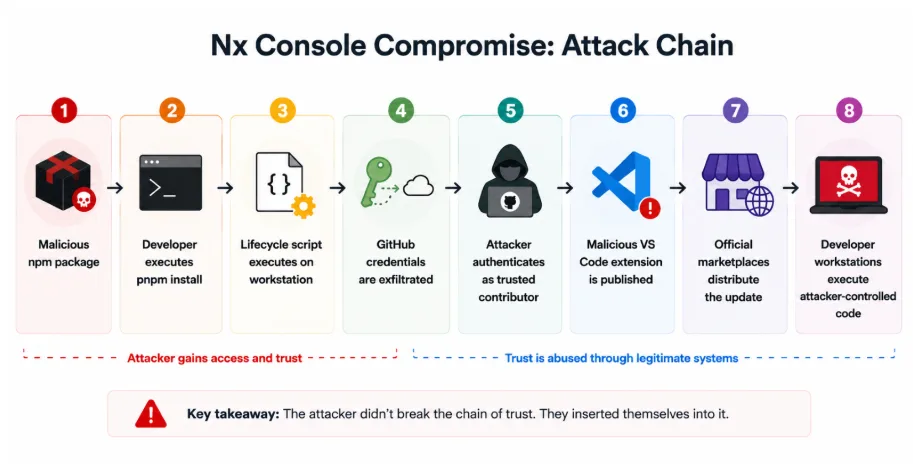
The chain, step by step:
- A poisoned
@tanstack/*dependency steals a contributor's GitHub token during a routine install. - The attacker uses those valid credentials to act as a legitimate maintainer.
- The attacker publishes a trojanized Nx Console through the project's normal release workflow.
- The marketplace distributes it as an authentic update.
- Automatic updates push it to installed clients within minutes.
None of the existing supply chain controls failed here. The attacker targeted a stage of the lifecycle that few organizations govern: software consumption.
Every artifact enters an organization through a decision to consume it. Developers install packages, IDE extensions, GitHub Actions, container images, and AI-recommended dependencies because they look trustworthy. Once that decision is made, the rest of the supply chain assumes the artifact belongs there.
The attacker did not exploit a marketplace vulnerability or bypass Microsoft's validation. They authenticated with valid contributor credentials, so the malicious release passed through the normal publishing workflow. From the marketplace's view, the extension looked like any legitimate update. The package name, publisher identity, version history, and distribution channel were unchanged. Every trust signal a developer relies on stayed intact.
This is a defining trait of modern supply chain attacks. Instead of hitting production infrastructure, attackers go after developer environments, where one compromised workstation can expose GitHub credentials, cloud tokens, SSH keys, and signing identities. Compromise one software producer, and you can reach thousands of consumers.
The attacker did not break the chain of trust. They inserted themselves into it. Once their code entered through a compromised developer environment, each downstream system faithfully passed along the assumption that everything upstream had already been verified.
That exposes a deeper question. If every downstream control assumes the initial consumption decision was sound, where is that decision actually governed?
Why Existing Controls Didn't Fail
It is easy to read the Nx Console compromise as a failure of supply chain security tooling. It wasn't.
Software Composition Analysis (SCA), Software Bills of Materials (SBOMs), code signing, artifact provenance, and runtime security each cover a specific stage of the lifecycle. They answer different questions:
Control | Primary Question |
|---|---|
SCA | What vulnerabilities exist in the selected dependency? |
SBOM | What components are present in the software we built? |
Code Signing & Provenance | Was this artifact produced by the expected publisher and build process? |
Runtime Security | Is the software behaving maliciously after deployment? |
this incident, none of these were bypassed. The attacker introduced malicious code before any of them became relevant.
The compromised extension was published by an authenticated maintainer through the legitimate release workflow. The marketplace distributed it because the publisher identity was valid. An SBOM would have accurately listed the components in the extension. A signature would have confirmed it came from the authorized publishing process. Every control operated exactly within its intended scope.
Here is the core problem. These controls begin working only after an artifact has been selected. They inventory, validate, scan, sign, and monitor software that is already part of the lifecycle. They do not evaluate whether that software should have been admitted in the first place.
This gap widens as development shifts toward assembling software rather than writing it. Applications are now composed from thousands of external artifacts pulled from package registries, container registries, IDE marketplaces, CI/CD integrations, and AI-generated recommendations. As the volume of consumed software grows, so does the number of implicit trust decisions developers make every day.
The missing control is not another scanner or runtime detector. It is a way to establish trust before software becomes part of the development workflow. If software consumption is a security control point, the next question is how to operationalize it.
Establishing Trust Before Software Is Consumed
The industry has spent a decade hardening the build and deployment pipeline. We have secured source repositories, hardened CI/CD systems, generated SBOMs, signed artifacts, and monitored production. Those investments improved our ability to secure software after it enters the lifecycle.
The Nx Console compromise points to a different problem. The supply chain does not begin when code is committed or a build starts. It begins earlier, when a developer selects an artifact to consume.
That decision has traditionally been left to individual developers, who lean on ecosystem signals like project popularity, maintainer reputation, marketplace validation, download counts, and community recommendations. These signals build confidence, but they were never designed to answer the question that matters most:
Can this software artifact be trusted for use within our organization?
Answering that means moving software consumption from an individual decision to an organizational capability. Instead of asking every developer to independently vet thousands of packages, extensions, and tools, organizations should establish trust centrally and make verified artifacts available for use. Verification becomes part of the supply chain itself, so software is evaluated before it enters development rather than after it has already become a dependency.
This verification goes beyond vulnerability scanning. It weighs provenance, dependency health, vulnerability exposure, licensing, maintenance activity, project maturity, and fit with organizational security policy. It also has to be continuous. Trust is not set once. It shifts as ecosystems, maintainers, and vulnerabilities change.
This is where solutions like Clean Libraries fit into the wider supply chain. Rather than replacing package ecosystems or developer workflows, they let organizations operationalize software consumption governance by giving developers and AI coding assistants access to verified artifacts that meet organizational trust requirements.
The goal is not to replace public ecosystems or limit developer choice. It is to make sure every artifact entering the lifecycle has already been checked against organizational trust requirements. As supply chains keep expanding through open source and AI-assisted development, governing consumption will become as fundamental as securing the build and deployment pipeline.
The first security decision in the supply chain is no longer how software is built. It is what software is allowed to enter the development lifecycle in the first place.