



The Next Software Supply Chain Challenge Is Trust
Software supply chain security has traditionally focused on identifying vulnerabilities faster.
Organizations deploy software composition analysis tools, scan dependencies for known CVEs, monitor security advisories, and accelerate remediation workflows. These practices remain essential for reducing risk.
However, the LiteLLM supply chain attack highlights a different and increasingly important challenge: software can become dangerous not because it contains a known vulnerability, but because organizations cannot verify whether the software artifact they consume is trustworthy.
In this incident, attackers did not exploit an unknown weakness in a production application. Instead, they compromised the software delivery process itself. A trusted open-source project became the distribution mechanism for malicious code, allowing attackers to target downstream development environments and collect sensitive credentials.
The lesson extends beyond LiteLLM.
Modern applications are assembled from thousands of external components, including open-source libraries, container images, build tools, and AI frameworks. Every component introduces a trust decision.
The fundamental question organizations must answer is no longer only:
"Does this software contain vulnerabilities?"
It is:
"Can we verify that this software artifact is what we expect it to be?"
What Happened in the LiteLLM Supply Chain Attack?
LiteLLM is an open-source AI gateway that provides a unified interface for applications integrating multiple large language model providers. As AI adoption accelerates, projects like LiteLLM have become important building blocks in modern AI application stacks.
The attack did not involve a fake package or an unknown project impersonating LiteLLM. Attackers compromised the legitimate software distribution process and published malicious versions of the LiteLLM package through PyPI, the official Python Package Index.
CleanStart previously analyzed the technical details of the incident, including how the two malicious LiteLLM versions (1.82.7 and 1.82.8) introduced credential theft capabilities into affected environments.
The compromised versions, including LiteLLM versions 1.82.7 and 1.82.8, were available through the legitimate package ecosystem and could be consumed through normal developer and CI/CD workflows.
The attack followed a software supply chain compromise pattern:
- A trusted component or workflow in the software development ecosystem was compromised.
- Attackers obtained access that allowed them to influence software publishing.
- Malicious LiteLLM packages were distributed through PyPI.
- Developers and automated systems downloaded the compromised packages.
- Malicious code executed inside trusted environments.
- Sensitive credentials and secrets were collected.
The attacker did not need to compromise every downstream organization individually.
They compromised software that organizations already trusted.
That is the defining challenge of modern software supply chain attacks.
Technical Analysis of the LiteLLM Attack
When Security Tooling Became Part of the Supply Chain Risk
The incident was linked to an earlier compromise involving Trivy, an open-source security scanner commonly used in CI/CD environments.
Analysis indicates that attackers leveraged compromised tooling and credentials to eventually affect the LiteLLM publishing workflow.
The important lesson is not about Trivy specifically. The lesson is broader:
Security tools are software.
They execute inside development environments. They consume dependencies. They interact with credentials. They operate within automated build systems.
They are therefore part of the software supply chain and require the same level of verification as application dependencies.
The attack path can be represented as:
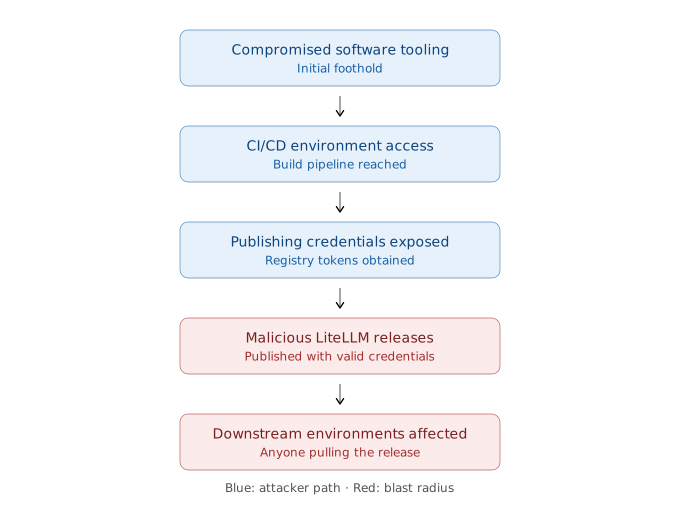
Organizations often treat security tooling as a trusted control layer.
This incident demonstrates that security tooling itself must be treated as a software artifact that requires verification.
How the Malicious Package Executed
One of the technically significant aspects of this attack was the execution mechanism.
The malicious LiteLLM releases included a Python .pth file. Python processes .pth files during interpreter initialization when configuring an environment. This means malicious code could execute without requiring developers or applications to explicitly import the compromised LiteLLM functionality.
The implication is important:
Installing the compromised package was enough to create an execution opportunity.
A developer did not need to intentionally call a malicious function or invoke a suspicious feature.
The malicious package targeted sensitive information from affected environments, including:
- Cloud credentials
- Kubernetes credentials
- SSH keys
- Environment variables
- CI/CD secrets
- AI provider API keys
For AI infrastructure, this creates an especially significant risk because AI gateways and orchestration layers frequently manage credentials required to access multiple external services.
A compromised dependency can therefore become a pathway into broader cloud and application environments.
Why Vulnerability Scanning Alone Was Not Enough
The security industry has made significant progress in vulnerability management.
Organizations now scan:
- Open-source dependencies
- Container images
- Infrastructure configurations
- Application components
These capabilities help identify known risks.
However, the LiteLLM incident demonstrates a limitation:
A malicious artifact does not need to contain a known vulnerability.
It can be:
- A legitimate package name
- Published through an official registry
- Associated with a trusted project
- Free of known CVEs
and still represent a serious security risk.
Traditional vulnerability management asks:
"Does this component have known security issues?"
Supply chain security requires a broader question:
"Can we prove this component was created and distributed through a trustworthy process?"
The difference is the move from vulnerability detection to artifact verification.
The Importance of the LiteLLM Container Image Path
One of the most valuable lessons from this incident is that software artifacts must be evaluated independently.
A software project can exist in multiple forms:
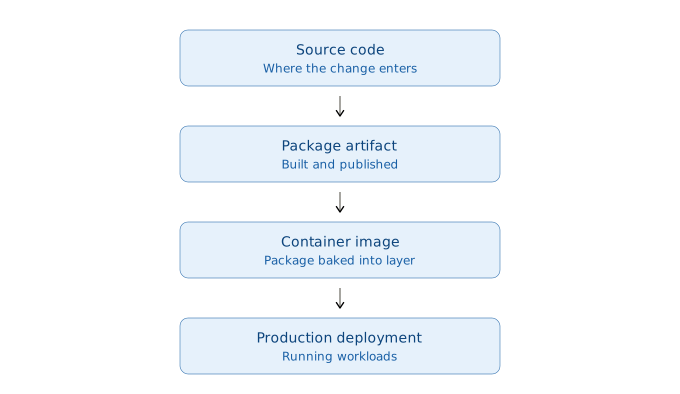
Each artifact represents a different trust boundary.
The LiteLLM team stated that official LiteLLM Proxy Docker images were not impacted because that deployment path used pinned dependencies and did not rely on the compromised PyPI packages.
This distinction matters.
A compromised package release does not automatically mean every container image built around that project is compromised.
Conversely, downloading software from a trusted source does not automatically guarantee that the resulting artifact has a trustworthy build process.
Organizations need confidence in the exact artifact they deploy.
Why Dependency Pinning Helps, But Does Not Solve the Problem
The LiteLLM incident highlighted the importance of dependency controls.
Pinning dependencies improves reproducibility by ensuring that builds do not unexpectedly consume changing package versions.
However, pinning alone is not enough.
A pinned artifact can still be unsafe if the artifact was already compromised when it was selected.
The stronger security model combines:
- Controlled dependency selection
- Artifact verification
- Build integrity
- Provenance validation
- Software transparency
The goal is not simply knowing what software was downloaded.
The goal is knowing whether that software deserves to be trusted.
Why AI Applications Need Stronger Software Supply Chain Security
The LiteLLM incident is particularly relevant because AI applications are increasingly built from interconnected software components.
A modern AI application stack may include:
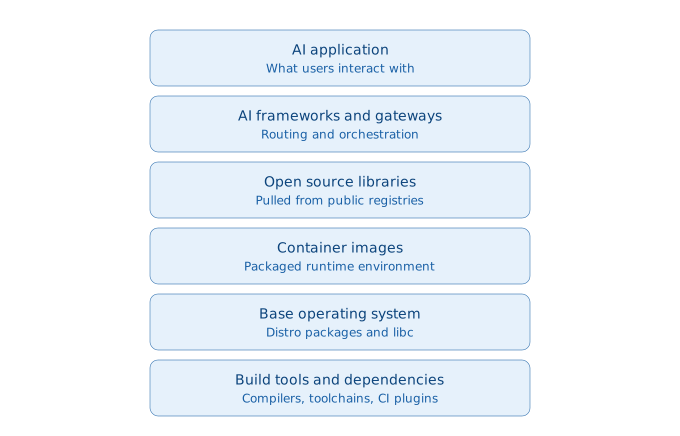
Every layer introduces a software trust decision.
Organizations need answers to fundamental questions:
- Where did this component originate?
- Who built it?
- What source code produced it?
- What dependencies were included?
- Was the artifact modified?
- Can the build process be verified?
As AI accelerates software development, the volume and complexity of software dependencies will continue increasing.
The need for verified software foundations will increase with it.
The Limits of Hardened Images and Single-Layer Security
A hardened container base image alone would not have prevented this specific attack.
A malicious application dependency can execute regardless of whether the underlying operating system layer is minimal or hardened.
However, this does not reduce the importance of secure software foundations.
The lesson is that software security cannot stop at one layer.
Modern applications require verification across:
- Container images
- Open-source libraries
- Dependencies
- Build systems
- Software artifacts
Security must follow the complete software supply chain.
Moving From Scanning Software to Verifying Software
The next evolution of software supply chain security is moving from detection-first approaches toward verification-first approaches.
Organizations need confidence in four areas:
Software Origin
Where did the artifact come from?
Can the organization verify its source and ownership?
Build Integrity
How was the software created?
Was the build process controlled, reproducible, and protected from unauthorized changes?
Artifact Transparency
What exists inside the software?
Do organizations have visibility through SBOMs and dependency information?
Artifact Integrity
Can organizations confirm that the artifact has not been modified after creation?
These controls create a foundation for software trust.
Where CleanStart Fits
The LiteLLM supply chain attack reinforces a broader principle:
Organizations should verify software artifacts before those artifacts become part of production systems.
CleanStart focuses on helping organizations establish trust in the software foundations they consume and deploy.
For containerized workloads, this means providing verified container images built through controlled processes with:
- Source-based construction
- Minimal software footprint
- SBOM transparency
- Cryptographic provenance
- Reduced vulnerability exposure
The same principle applies beyond containers. Modern applications depend on thousands of libraries and components, making software dependency verification increasingly important.
The future of software supply chain security is not only about discovering unsafe software faster.
It is about reducing uncertainty before software enters the environment.
The Bigger Lesson
The LiteLLM incident was not simply another package compromise.
It was a reminder that software trust cannot be assumed.
The industry has become increasingly effective at finding vulnerabilities inside software. The next challenge is proving that the software itself can be trusted before it enters the supply chain.
Because in a modern software ecosystem:
The most dangerous artifact is not always the one with the most vulnerabilities. It is the one nobody verified.