


Are you looking for Chainguard alternatives? You're probably trying to answer a bigger question: which hardened container image platform is the right fit for your organization? You may be looking to reduce inherited vulnerabilities, strengthen software provenance, meet compliance requirements, expand language or runtime coverage, or simply compare what's available before making a decision.
Today's hardened container image market offers several capable vendors, each taking a different approach to building, securing, and verifying container images. This article provides a vendor-neutral framework for evaluating those approaches, then compares how Chainguard, Docker Hardened Images, Minimus, RapidFort, Red Hat, and CleanStart measure up against those criteria.
Two of those criteria get less attention than they deserve: whether a vendor screens for malicious intent in a package, not just known CVEs, and whether it evaluates the trustworthiness of the people submitting code. Both matter more as AI coding assistants pull in dependencies faster than any human review can keep up.
What Chainguard Actually Is
Chainguard sells hardened, minimal container images built on Wolfi, its own purpose-built Linux distribution. It rebuilds them from source on a regular cadence through what it calls its Factory pipeline. Each image ships with SBOMs, Sigstore-compatible signatures, and SLSA-aligned provenance.
In 2026, Chainguard added a source-code scanner aimed at greyware. Greyware describes packages that behave as advertised but carry hidden risk, such as credential harvesting or command-and-control behavior. This scanner currently covers the npm/JavaScript ecosystem only.
Chainguard also offers a broad catalog of container images and has expanded beyond container security with its Repository product, which applies similar governance principles across containers, software libraries, operating system packages, CI/CD artifacts, and AI agent skills. This reflects a broader software supply chain strategy beyond hardened container images.
Understanding these capabilities provides useful context, but they represent just one approach to delivering hardened container images. The next section looks at why organizations evaluate alternatives and how different vendors take different architectural approaches.
Where Teams Look for Chainguard Alternatives
- Broader Catalog and language coverage. Strength in one ecosystem does not guarantee coverage for a niche runtime a team needs next quarter.
- Pricing and licensing fit. Enterprise pricing models, licensing terms, and MSSP or ISV redistribution options vary significantly across vendors and may influence procurement decisions.
- Detection depth beyond known CVEs. A "zero-CVE" claim says nothing about whether a package's source code or submitter has been checked for malicious intent.
- Operational model. Some images keep a shell to stay compatible with existing Helm and Bitnami deployment patterns. Others are genuinely shell-less by default. That choice changes what happens after an attacker exploits an unrelated, unknown vulnerability.
- Compliance and geography. FedRAMP, FIPS 140-3, DISA STIG, and air-gapped or on-prem requirements point different teams toward different vendors.
None of the points below mean Chainguard is a poor choice. They mean fit is not universal, which is true of every vendor in this list, including CleanStart.
A Scorecard for Any Hardened Image Vendor
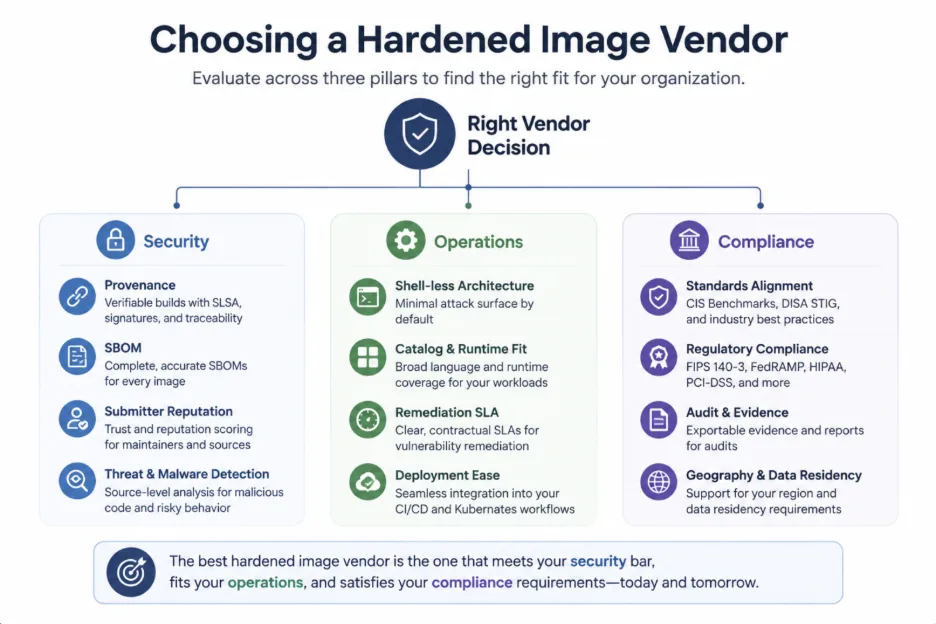
Use the same eight questions against every vendor on your shortlist. Ask for a proof-of-concept answer, not a slide.
1. Vulnerability Posture and Rebuild Cadence
For a named image and digest, ask three things. How many CVEs does the vendor publish? Under what severity methodology? How fast does a new digest ship after an upstream patch? A published, checkable methodology beats a "near-zero CVE" claim on its own.
2. Malicious Code and Behavioral Detection
Does the vendor analyze source code for malicious logic before it compiles a package into an image? That means catching obfuscated behavior, suspicious network calls, and credential harvesting patterns. Or does it only scan the finished binary against known-malware signatures? This capability is materially different and unevenly distributed across the market.
3. Submitter and Maintainer Reputation
Is there any mechanism that evaluates the trustworthiness of a package's source or maintainer, independent of whether a CVE exists? A compromised maintainer account publishing a clean-looking update is exactly the scenario a CVE database cannot catch in time.
4. SBOM, Provenance, and Signing
Are SPDX or CycloneDX SBOMs available per digest? Do they come with Sigstore/Cosign-compatible signatures and a documented SLSA level? Ask which level. Ask to see the pipeline description too, because an unverified claim does not survive an audit.
5. Attack-Surface Architecture
Is the image genuinely shell-less and read-only by default? Or does it keep a shell and standard core utilities to preserve drop-in compatibility with existing tooling? This decides what an attacker can do after an unrelated exploit succeeds. That is a different question from how many known CVEs the image carries.
6. Catalog Depth and Runtime Fit
Does the vendor cover the specific language versions, web servers, and data-plane dependencies your team runs today? Or only on a roadmap?
7. Compliance Mapping
Which controls are mapped per image, such as CIS, STIG, FIPS 140-3, and FedRAMP? And where does the vendor export the evidence for an auditor?
8. Remediation Model
Is there a contractual remediation SLA with a specific day count for Critical and High findings? Or just a best-effort rebuild cadence with no committed timeline?
How the Current Field Compares
Vendor | Build model | Malicious code / behavioral detection | Submitter reputation | Shell-less default |
Chainguard | Rebuilt from source (Wolfi/Factory) | Partial. Greyware scanner, npm only | Partial. Maintainer-behavior anomaly flags | Yes |
Docker Hardened Images | Hardened variants of Debian/Alpine | Not described publicly | Not described publicly | Varies by image |
Minimus | Rebuilt from source | Not described publicly | Not described publicly | Yes |
RapidFort | Optimizes/repackages existing images (incl. Iron Bank) | Not described publicly | Not described publicly | Depends on source |
Red Hat Hardened Images | Enterprise/OpenShift catalog, GA 2026 | Not described publicly | Not described publicly | Varies by image |
CleanStart | Compiled from source, hermetic zero-network build | Yes. Source-level AST + behavioral analysis, 8 languages / 9 ecosystems | Yes. Dedicated scoring, independent of CVE status | Yes, every variant |
Remediation SLA by Vendor
- Chainguard: Continuous rebuilds, no fixed contractual day-count publicly stated.
- Docker Hardened Images: Not publicly detailed as a fixed SLA.
- Minimus: Vendor-published target of 48 hours for critical findings. Confirm current terms directly.
- RapidFort: Not publicly detailed as a fixed SLA.
- Red Hat: Tied to support subscription terms.
- CleanStart: Contractually backed. 7 days for Critical, 14 days for High, Medium, and Low.
Figures for vendors other than CleanStart reflect each company's own published materials as of mid-2026. Confirm current terms directly with each vendor before you include them in a regulated procurement package.
Match a Vendor to Your Situation
- Small teams (roughly 1 to 50 engineers): Prioritize clear documentation, predictable pricing, and a fast path to a working pilot over catalog breadth.
- Mid-market (roughly 50 to 500 engineers): Standardize on an approved base and wire CI/CD signature verification. Plan for admission-policy enforcement with OPA or Kyverno from the start rather than retrofitting it later.
- Enterprise (500+ engineers): Procurement, multi-cloud fit, and a named contractual remediation SLA matter more than catalog size alone. Ask for the exact SLA wording, not a marketing summary.
- Regulated environments (FedRAMP, HIPAA, PCI-DSS, defense): Treat compliance mapping and FIPS 140-3 validation as pass/fail requirements. Confirm which specific controls are mapped per image rather than accepting a general compliance claim.
Why Malicious Code Detection and Submitter Reputation Matter
Every vendor here can reasonably claim a low or near-zero known-CVE count. That is table stakes now, not a differentiator.
A CVE count cannot tell you two important things. It cannot tell you whether a package that scans clean today came from a compromised maintainer account. , or contains logic that behaves maliciously without matching any known vulnerability signature
Source-level static and behavioral analysis closes part of that gap. Independent evaluation of submitter trustworthiness closes the rest. Together they address a class of supply-chain risk that vulnerability scanning structurally cannot catch until after the fact. As AI coding assistants pull in dependencies with less human review, this gap grows with each release cycle.
What Comes After You Pick a Base Image
A hardened base image is one layer, not the whole program. Teams still need three more things.
- Admission control to enforce that only signed, verified images run in production.
- Runtime detection for threats that do not originate in the base image.
- A documented plan for when an unrelated zero-day appears in a component every vendor's scanner currently shows as clean.