



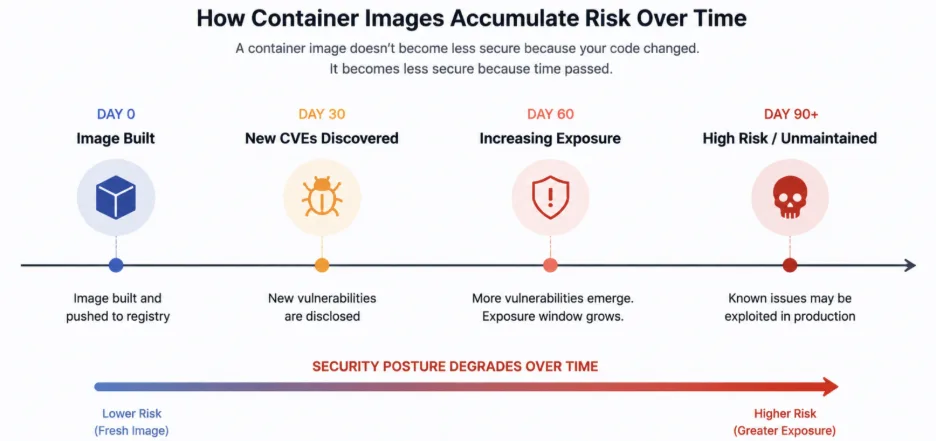
A container image doesn't become less secure because your application code changed. It becomes less secure because time passed.
Every day a container image sits unrebuilt in a registry, the operating system packages and libraries inside it continue aging against newly disclosed vulnerabilities that did not exist when the image was originally built.
Patch cadence, the frequency at which organizations rebuild, rescan, and redeploy container images, determines how long that exposure window remains open.
The urgency behind this question has changed. The window between vulnerability disclosure and active exploitation has compressed significantly. Attackers are increasingly exploiting vulnerabilities before or shortly after public disclosure, leaving organizations with less time to identify, remediate, and deploy fixes.
A monthly or quarterly rebuild schedule may have been acceptable when vulnerability exploitation took longer. Today, slow rebuild cycles can leave known risks present in production environments for extended periods.
This guide explains why patch cadence matters, how published standards compare, and how organizations can build automated rebuild processes into their CI/CD pipelines without turning vulnerability remediation into a manual operational burden.
Why Patch Cadence Matters More Than the Patch Itself
The challenge with container security is not simply that vulnerabilities exist. The bigger challenge is that vulnerabilities can accumulate silently inside images that are no longer actively maintained.
An image built months ago may still run successfully, but the packages and dependencies inside it continue changing from a security perspective as new vulnerabilities are discovered. Without a defined rebuild and remediation process, the gap between when a vulnerability becomes known and when an organization deploys a fixed image can continue to grow.
Research analyzing 261 Docker Hub base images found 1,983 exploitable vulnerabilities across the sample and reported that 91.6% of analyzed GitHub containerized projects depended on a base image with at least one known vulnerability.
The study should not be interpreted as a current vulnerability count. Instead, it demonstrates a recurring operational pattern: teams often pull a base image, approve it, deploy it, and then fail to revisit it as the underlying software ecosystem changes.
That is why patch cadence matters. Security is not determined only by whether a vulnerability is fixed. It is also determined by how quickly organizations can rebuild, verify, and redeploy affected images after new risks emerge.
How Fast Is Fast Enough? Comparing Published Cadence Standards
There is no single universal answer to how often organizations should rebuild container images. The right cadence depends on factors such as vulnerability severity, exposure level, regulatory requirements, and operational constraints.
However, three reference points help illustrate the range:
- Vendor-managed hardened image providers often operate with aggressive remediation timelines supported by automated rebuild pipelines.
- Federal guidance establishes severity-based remediation expectations for government environments.
- Many enterprise teams still rely on monthly or quarterly release cycles, creating a significant gap between vulnerability discovery and remediation.
Where does your organization fall?
If your current process is: “We patch containers when we patch everything else.”
you are likely operating closer to a monthly or quarterly cycle.
Moving toward severity-based timelines, such as the CISA tiers, is a meaningful improvement because it prioritizes risk instead of treating every vulnerability equally.
Moving toward tighter timelines, such as the 1/7/14-day model used by some hardened image providers, requires a higher degree of automation: continuous scanning, automated rebuilds, and efficient image distribution workflows.
The goal is not simply to rebuild faster. The goal is to reduce the time between vulnerability discovery, remediation, verification, and deployment.
Building Patch Cadence into Your CI/CD Pipeline
Choosing a rebuild cadence is the easy part. The harder challenge is making sure that cadence happens consistently without relying on manual processes or someone remembering to trigger a rebuild.
A practical container maintenance strategy connects vulnerability detection, image rebuilds, verification, and deployment workflows together.
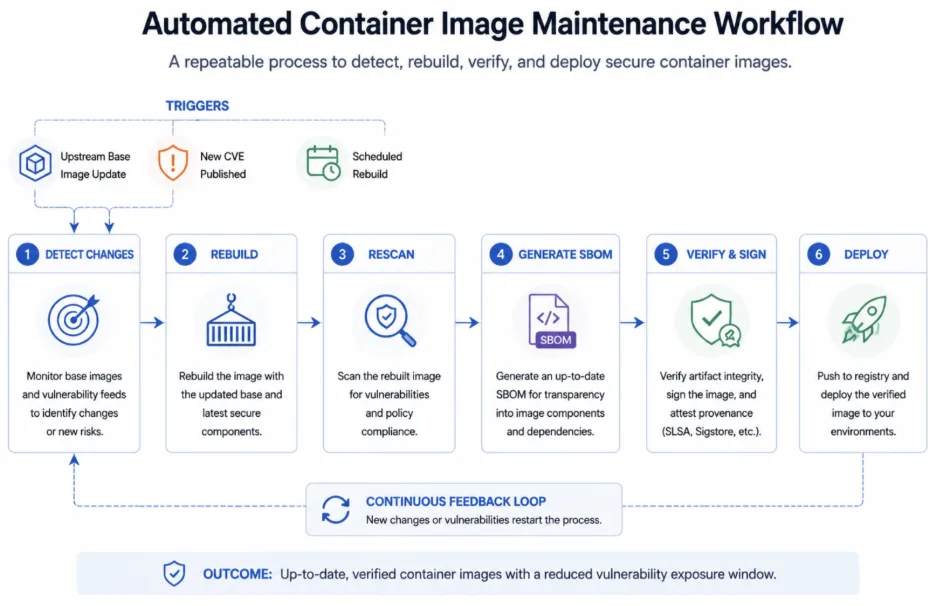
However, rebuilding an image is only one part of maintaining software supply chain security. Organizations also need confidence that the rebuilt artifact is the intended artifact, produced through a controlled process, and ready to be trusted in production.
A mature rebuild workflow therefore combines vulnerability remediation with software transparency and artifact verification, including SBOM generation, build provenance, and cryptographic signing before deployment.
Scan at Three Trigger Points
A single scan during image creation only identifies vulnerabilities known at that moment. New vulnerabilities can emerge after an image has already been published, even when no application code has changed.
A mature workflow typically scans at three points:
Every pull request or build
Detect vulnerabilities introduced before changes merge into the main codebase.
Every push to main
Validate the security posture of artifacts moving toward release.
On a recurring schedule
Scan existing registry images for vulnerabilities disclosed after deployment.
This recurring scan is often the most important step because it addresses the scenario where the image has not changed, but the vulnerability landscape has.
Run Independent Security Scanners
No single scanner identifies every possible issue.
Many organizations use multiple scanners, such as Trivy and Grype, as a defense-in-depth approach. The goal is not to assume one tool is perfect, but to reduce blind spots by using different vulnerability databases and matching approaches.
Scanner results are only useful when teams understand what is inside the image. This is where SBOMs provide additional visibility into the components and dependencies being evaluated.
Pin Digests, Not Tags
A rebuild process is only reproducible when teams know exactly what content they are rebuilding from.
Referencing images by mutable tags such as:
node:20 python:3.12 can result in different content being pulled at different points in time.
Pinning base images by SHA256 digest ensures that teams can identify the exact artifact being consumed and deliberately update it when changes are approved.
Define Severity-Based Rebuild SLAs
Not every vulnerability requires the same response window.
A practical model ties rebuild urgency to severity:
Severity | Suggested Rebuild Window |
Critical / Known Exploited | Within 24 hours of a qualifying patch |
High | Within 7 days |
Medium / Low | Batched into scheduled refresh cycles |
These timelines should be adapted based on workload exposure, business impact, and regulatory requirements. Internet-facing production workloads typically require tighter windows than internal systems.
Automate Scheduled Rebuilds and Dependency Updates
Beyond vulnerability-triggered rebuilds, organizations should maintain scheduled jobs that:
- re-evaluate upstream base image digests
- rebuild affected images
- rescan security posture
- generate reviewable changes before deployment
Base image changes should be treated as software supply chain events, not simple dependency updates.
When an upstream image releases a security update, organizations should automatically evaluate affected application images, rebuild them against the updated foundation, regenerate security metadata, and verify the resulting artifact before release.
Registry webhooks can also trigger downstream rebuilds when upstream base images change, reducing the gap between a patched base image becoming available and applications consuming that update.
Next Step
Patch cadence is a policy decision before it is a pipeline configuration.
Organizations need to decide what level of vulnerability exposure is acceptable, define severity-based rebuild expectations, and then build the automation required to achieve that cadence.
Whether an organization follows a vendor-managed remediation model, a federal risk-based timeline, or an internal operating standard, the objective is the same:
Reduce the time between vulnerability discovery, remediation, verification, and deployment.
The pipeline mechanics are straightforward once the target cadence is defined. The harder part is establishing the ownership, processes, and automation required to maintain that security posture over time.
Organizations that do not want to operate the entire rebuild and remediation lifecycle internally can adopt verified hardened images, where artifact maintenance, security evidence, and verification capabilities are built into the image delivery process. Platforms such as CleanStart provide verified container images that combine hardened foundations with ongoing rebuilds, vulnerability remediation, SBOMs, and artifact verification.


