


The availability of free and community-supported hardened container images has made it easier for development teams to adopt more secure software foundations. Organizations no longer need to start every container build with a general-purpose base image and manually remove unnecessary components, dependencies, and runtime tooling.
Recent industry developments have increased awareness around hardened container images and lowered the barrier for teams exploring more secure container image foundations.
But access to a hardened image is only the starting point.
A production container image is not just a collection of packages that runs an application. It is a software artifact that becomes part of an organization's software supply chain and requires evidence of how it was built, what it contains, how it is verified, and how it is maintained over time.
This distinction matters because a hardened image is more than a smaller image with fewer vulnerabilities. True hardening requires a combination of reduced attack surface, secure build practices, software transparency, continuous maintenance, and verifiable evidence about the artifact.
For developers and platform teams evaluating hardened images, the key question is no longer only:
"Can we get a hardened container image?"
The more important question is:
"Can we trust, verify, and maintain the software foundations our applications depend on?"
What Changed with the Rise of Free Hardened Images?
The adoption of hardened container images has historically required teams to make a choice: invest engineering effort in building and maintaining their own hardened image pipeline or rely on external sources and providers that manage some or all of the image lifecycle.
The growing availability of free and community-supported hardened images has changed that equation. Development teams can now explore more secure container foundations without first committing to a commercial solution or building every security control themselves.
This shift matters because the starting point of a container build has a direct impact on the security of everything that follows. A minimal image with fewer unnecessary components can reduce attack surface, while security metadata such as SBOMs, signatures, and provenance can provide greater visibility into the artifact being deployed.
Recent industry developments have accelerated awareness of hardened image approaches and made it easier for teams to evaluate more secure container foundations.
However, easier access does not eliminate the need for security evaluation.
A production image is not secure simply because it is smaller, has fewer vulnerabilities at release, or is available from a trusted source. Organizations still need to understand how the image was built, what controls protect the build process, how updates are delivered, and whether the artifact can be continuously verified throughout its lifecycle.
For developers experimenting with hardened images, free availability removes an important barrier.
For enterprises running critical workloads, the question becomes broader:
Can we establish confidence in the software artifacts we deploy, maintain, and operate over time?
Free Images Solve Adoption, Not the Full Security Lifecycle
A hardened container image can significantly improve a team's security baseline by reducing unnecessary components and limiting runtime attack surface. Starting with a minimal, hardened foundation is a meaningful improvement over building applications on general-purpose images with unnecessary packages, tools, and dependencies.
However, the image itself is only one point in the software supply chain.
Security teams and platform teams need confidence in the complete lifecycle of the artifact:
- How was the image built?
- What source components were included?
- Can the contents of the image be verified?
- How quickly are newly discovered vulnerabilities addressed?
- Is there evidence that the artifact deployed is the artifact that was built?
- Who owns maintaining the security baseline over time?
These questions become increasingly important as organizations scale container adoption. A team may start with a hardened image, but without a consistent process for monitoring, rebuilding, and verifying artifacts, security can still degrade over time.
From Smaller Images to Verifiable Software Artifacts
Reducing image size and removing unnecessary components are important parts of hardening. Fewer packages, fewer utilities, and fewer runtime dependencies can reduce the available attack surface.
But size reduction alone does not answer the larger trust question.
Two images may contain a similar application runtime while providing very different levels of assurance depending on:
- how the image was built
- where the components came from
- whether builds are reproducible
- whether the artifact is signed
- whether provenance is available
- whether the software inventory is maintained
This is why hardened images are increasingly evaluated as software artifacts, not just container files.
The Controls That Establish Trust
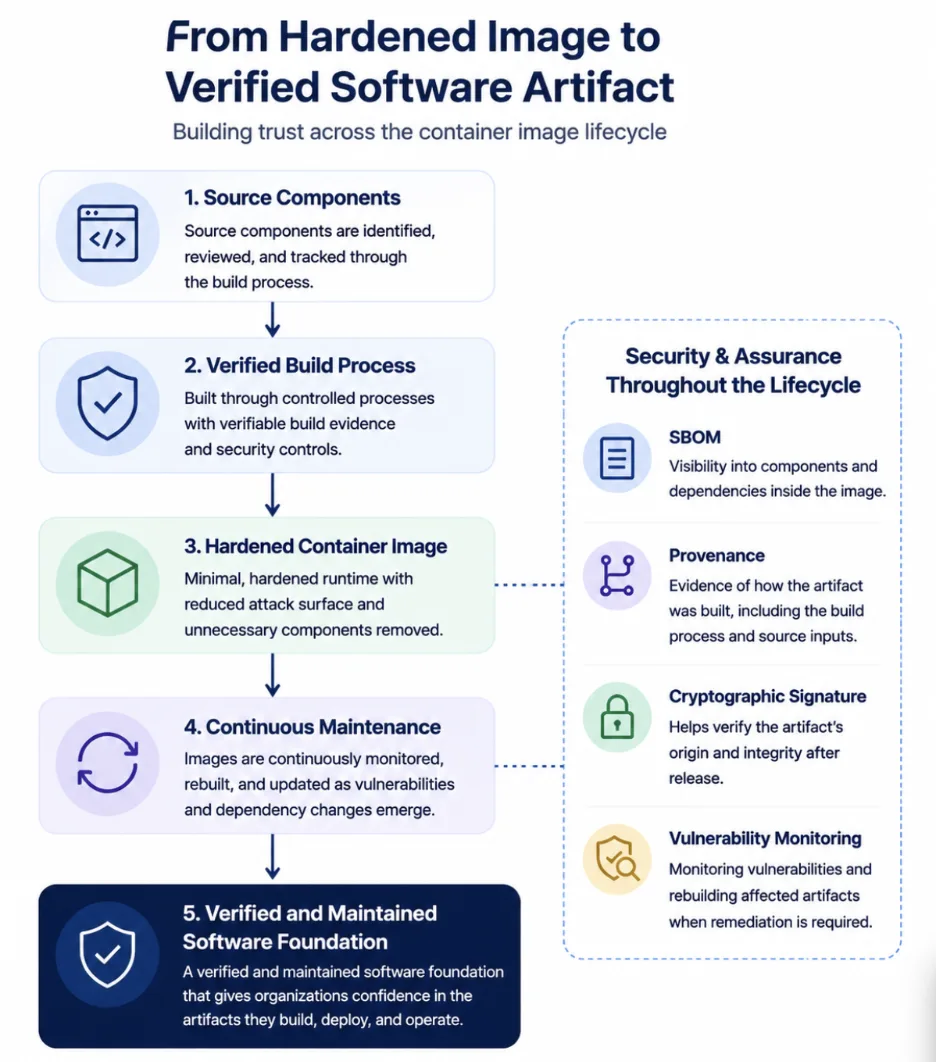
A mature hardened image program typically combines several security controls:
Software Bill of Materials (SBOM)
An SBOM provides visibility into the packages, libraries, and components contained in an image. This helps teams understand what they are deploying and determine whether newly disclosed vulnerabilities affect their workloads. CleanStart Images expose SBOMs alongside image artifacts to provide component transparency.
Cryptographic Signing
Signing helps verify that the image came from the expected publisher and that the artifact has not been altered after release.
Build Provenance
Provenance provides evidence about how an artifact was created, including information about the build process and source inputs. This allows organizations to move beyond trusting only the image tag or registry location.
Continuous Maintenance
A hardened image is not a one-time security decision. New vulnerabilities, dependency changes, and upstream updates require a process for rebuilding and releasing updated artifacts.
The difference is between:
"This image was hardened when it was created."
and:
"This image continues to be maintained as a verified security artifact."
Why This Matters for Enterprise Workloads
For developers experimenting with hardened images, free and community options can be an excellent way to adopt stronger defaults and reduce inherited risk.
For production environments, especially regulated workloads, organizations often need additional assurance:
- documented remediation processes
- compliance evidence
- verified build practices
- artifact traceability
- operational ownership
The question shifts from:
"Can we download a hardened image?"
to:
"Can we continuously trust the software artifacts running in our environment?"
How Enterprises Should Evaluate Hardened Container Image Programs
The availability of free and community-supported hardened images gives organizations more options than ever before. But selecting a container image for production workloads requires looking beyond image availability or initial vulnerability counts.
A hardened image becomes part of the software supply chain. Organizations should evaluate not only what is inside the image, but also the processes and controls that surround it.
The following areas can help teams evaluate whether a hardened image approach meets their security and operational requirements.
1. How Is the Image Built and Verified?
The security of a container image starts with the build process.
Organizations should understand:
- Where the source components originate
- How dependencies are selected and maintained
- Whether builds occur in controlled environments
- Whether the resulting artifact can be traced back to its source
- Whether provenance information is available
A published image tag alone provides limited assurance. Security teams increasingly need evidence that the artifact being deployed is the artifact that was built and reviewed.
Build provenance and cryptographic signing help establish this chain of trust by providing information about how an artifact was created and allowing teams to verify its integrity. CleanStart images expose provenance and SBOM information as part of the image artifact lifecycle.
2. How Are Vulnerabilities Managed After Release?
A hardened image is not secure forever simply because it was secure when published.
New vulnerabilities can affect software components after deployment, requiring a process for:
- Monitoring vulnerability disclosures
- Identifying affected components
- Rebuilding images
- Publishing updated artifacts
- Communicating remediation status
The important question is not only:
"How many vulnerabilities does this image have today?"
It is:
"What happens when a new vulnerability is discovered tomorrow?"
A strong hardened-image program treats maintenance as an ongoing security process rather than a one-time image build.
3. What Security Evidence Is Available?
Modern software security requires more than trusting a registry location or vendor name.
Organizations should evaluate whether the image includes:
SBOMs
A Software Bill of Materials provides visibility into the components included in an image and helps teams determine whether newly disclosed vulnerabilities affect deployed software.
Provenance
Build provenance provides evidence about how an artifact was produced and what processes generated it.
Signing
Cryptographic signatures help verify that the artifact came from the expected publisher and has not been altered.
Together, these controls allow security teams to move from assumptions to verification.
4. Does the Image Support Your Compliance Requirements?
Not every workload has the same security requirements.
A development environment may prioritize convenience and accessibility, while regulated production environments may require:
- Security documentation
- Compliance evidence
- Cryptographic controls
- Defined remediation processes
- Audit-ready artifact information
Organizations should evaluate hardened images against the requirements of their environment rather than simply selecting the smallest or most popular option.
5. Who Owns the Image Lifecycle?
This is often the most overlooked question.
A free hardened image may reduce the initial effort required to adopt a secure baseline. However, organizations still need to decide who is responsible for:
- Tracking updates
- Validating changes
- Managing vulnerabilities
- Maintaining compatibility
- Providing evidence during audits
Some teams have the resources to manage this lifecycle internally. Others prefer a managed approach where more responsibility is shared with the image provider.
The right choice depends on the organization's security maturity, engineering capacity, and risk requirements.
6. Does the Image Fit Existing Developer Workflows?
Security improvements only succeed when teams can adopt them without creating unnecessary friction.
Organizations should evaluate:
- Runtime compatibility
- Supported languages and frameworks
- Registry compatibility
- CI/CD integration
- Migration effort
- Debugging workflows
The strongest hardened-image approach improves security without forcing teams to completely redesign how they build and deploy software.
The Evaluation Question Has Changed
The container security conversation is moving beyond:
"Which image has the fewest vulnerabilities?"
toward:
"Which software foundation gives us the confidence to build, deploy, and operate securely?"
Free and community images have made hardened approaches more accessible. Enterprise teams must now determine what additional assurance, visibility, and operational support they require for production workloads.
Evaluating Hardened Container Image Approaches
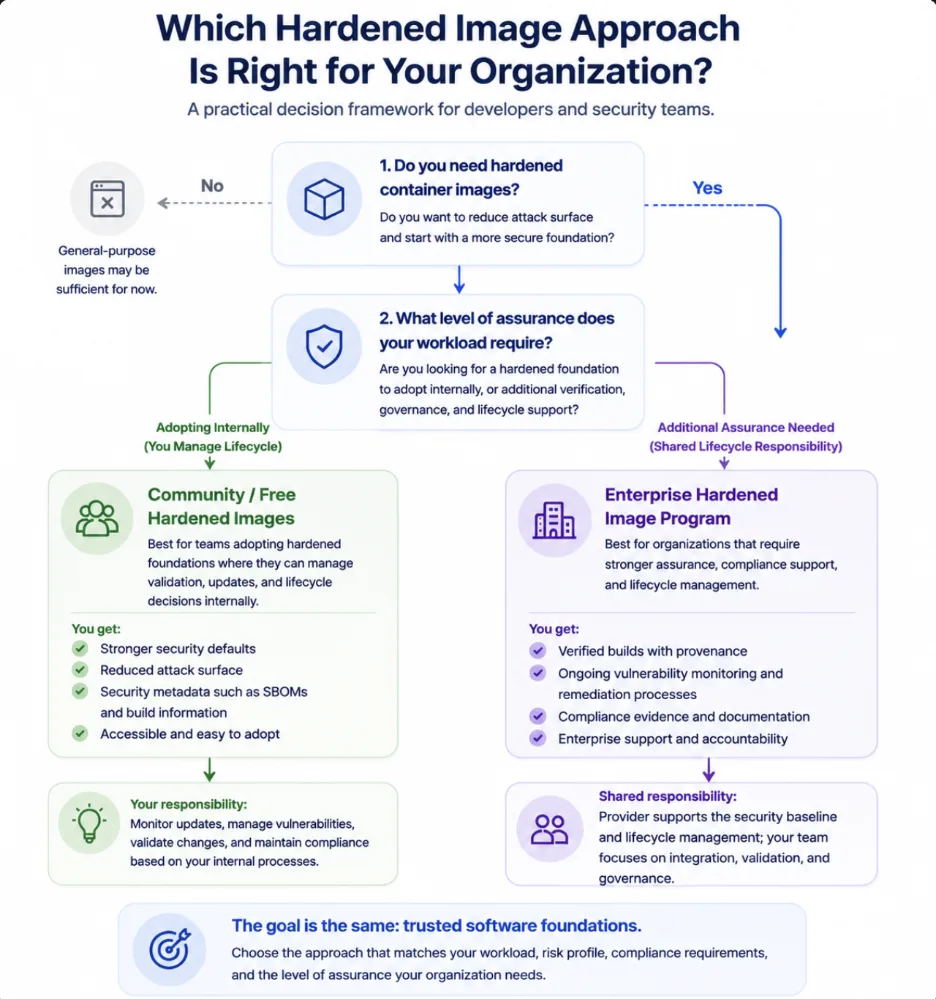
Not every organization needs the same level of support, governance, or security evidence from a container image provider.
A developer experimenting with hardened images may prioritize accessibility and ease of adoption. A financial services organization, healthcare provider, or government contractor may require stronger guarantees around provenance, remediation, compliance, and operational accountability.
The right approach depends on the workload, regulatory environment, and the level of assurance required.
Evaluation Area | Community / Free Hardened Images | Enterprise Hardened Image Programs |
Primary objective | Provide easier access to hardened container foundations and secure defaults | Provide a managed security foundation with additional assurance and accountability |
Attack surface reduction | Remove unnecessary packages, tools, and runtime components | Combine minimal runtime design with controlled lifecycle management |
Software visibility | Provide visibility into image contents through metadata such as SBOMs | Integrate SBOMs, provenance, and artifact evidence into security workflows |
Artifact verification | May include signatures and build metadata depending on the provider | Provide stronger verification controls around artifact integrity and build processes |
Vulnerability management | Teams consume updates and manage lifecycle decisions based on available processes | Defined processes for monitoring, remediation, rebuilding, and communicating updates |
Compliance requirements | Suitable for evaluation, development, and workloads with fewer regulatory requirements | Designed for environments requiring additional security evidence and compliance support |
Operational ownership | Organization is responsible for validation, updates, and governance decisions | Provider shares responsibility for maintaining the security baseline |
Customization and support | Often community-driven or self-managed | Enterprise support, customization, and lifecycle commitments |
How CleanStart Builds Verified Container Foundations
For many teams, community hardened images are an important first step toward reducing inherited software risk. They make stronger security defaults available earlier in the development process and allow organizations to evaluate hardened approaches without significant barriers.
For enterprise workloads, however, the requirement often extends beyond obtaining a hardened image. Organizations need confidence that the software artifacts they deploy can be:
- verified
- continuously maintained
- traced back to its source
- evaluated against compliance requirements
- supported throughout its lifecycle
This is the approach behind CleanStart's verified container images. CleanStart focuses on building hardened software foundations with reduced attack surface, SBOM visibility, signed provenance, and continuous lifecycle management so teams can establish greater confidence in the artifacts they deploy.
CleanStart approaches container security by treating images as verified software artifacts, combining hardened image foundations with security controls that provide visibility and assurance throughout the artifact lifecycle.
CleanStart images are designed around four core principles:
Reduced Attack Surface
CleanStart hardened images remove unnecessary components and runtime dependencies to provide a more secure foundation for modern applications.
Software Transparency
SBOMs provide visibility into the components included in each image, helping organizations understand what they deploy and respond more effectively when new vulnerabilities emerge.
Artifact Verification
Cryptographic signing and build provenance provide evidence about how artifacts were created and help teams verify that deployed images match trusted builds.
Continuous Lifecycle Management
Security does not end when an image is published. Continuous maintenance, rebuilding, and vulnerability remediation help organizations maintain a stronger security baseline over time.
For organizations evaluating hardened container images, the key question is not only how an image is built, but how confidently it can be verified, maintained, and trusted throughout its lifecycle.
Learn more about CleanStart Verified Container Images → CleanStart Images - secure, hardened container images
Conclusion
Hardened Images Are Becoming More Accessible. Trust Still Requires Verification.
The availability of free and community-supported hardened container images is a positive step for the software ecosystem. It gives more teams the opportunity to start with stronger security defaults instead of relying on general-purpose images with unnecessary components and inherited risk.
But access to a hardened image is only the beginning.
Organizations building production software need confidence in the complete lifecycle of the artifacts they deploy. That means understanding how images are built, verifying what they contain, maintaining them as vulnerabilities evolve, and having evidence that supports security and compliance decisions.
The future of container security is not only about making hardened images available. It is about creating software foundations that organizations can verify, maintain, and trust throughout the software supply chain.