



Modern applications are built on an expanding foundation of open source software. A single application can depend on hundreds or thousands of external components, each introducing a decision about what software an organization is willing to trust.
Go has addressed one important part of this challenge exceptionally well: dependency integrity.
Through mechanisms such as go.sum and the Go checksum database, the Go toolchain helps developers verify that dependencies have not been unexpectedly modified after publication. This provides a strong defense against tampering and unauthorized changes during software distribution.
However, software trust requires more than knowing that an artifact has not changed. Organizations increasingly need to answer deeper questions about the software they consume: whether the dependency corresponds to the intended source code, who published it, how it was created, and whether the evidence behind it can be independently verified.
This distinction separates integrity from provenance.
Integrity confirms that software is consistent with what was previously recorded. Provenance provides evidence about where software came from and how it was created.
As software supply chains become more complex, and AI-assisted development accelerates the creation and adoption of software components, provenance is becoming an essential part of software trust.
Key Takeaway
go.sum provides strong integrity guarantees - however integrity is just one layer of software trust. The Go checksum model answers an important question: "Is this the same dependency that was previously verified?" By recording cryptographic hashes and validating them through the Go checksum database, Go helps detect unexpected changes to published modules. However, it does not establish where the artifact came from, how it was created, or whether it should be trusted.
Question | What is required | Does go.sum answer it? |
Has the artifact changed? | Integrity verification | Yes |
Where did the artifact come from? | Source and provenance evidence | No |
How was the artifact created? | Build evidence and attestations | No |
Should this component be trusted? | Verification and security analysis | No |
A secure software supply chain requires moving beyond simply verifying that software has not changed toward establishing evidence that explains why the software should be trusted.
1. What Go Handles Well: Dependency Integrity
Go was designed with strong reproducibility and dependency integrity principles.
When a developer adds a dependency, the Go toolchain resolves the requested module version, downloads the module source, calculates cryptographic hashes, and records those hashes in go.sum. When the dependency is used again, Go verifies that the content matches the previously recorded values.
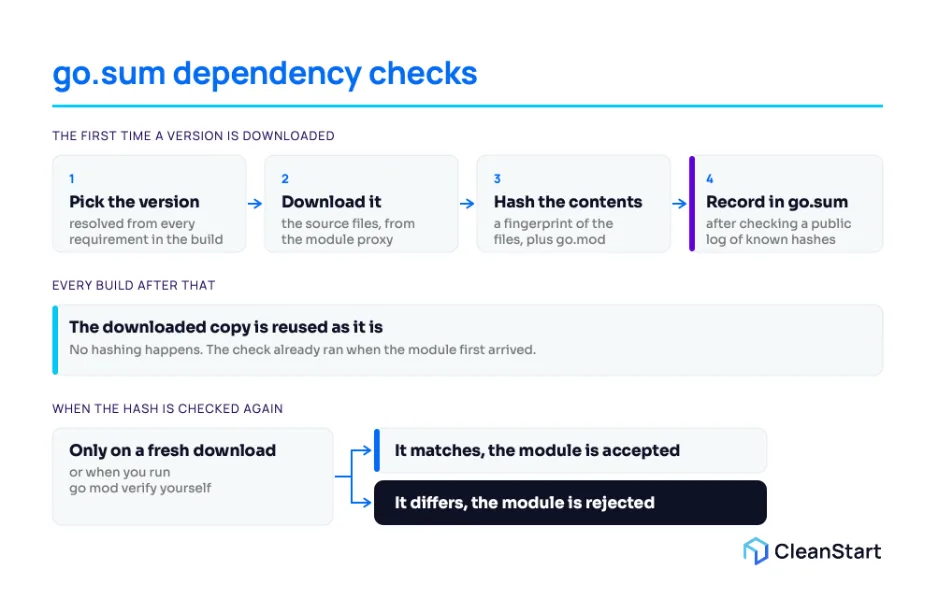
The result is a powerful guarantee:
The dependency being consumed is the same dependency that was previously verified.
The Go checksum database extends this model by providing a public transparency layer for module hashes. In technical cryptographic terms, this is an append-only Merkle tree structure for chaining the hashes together. It allows the ecosystem to detect unexpected edits and prevent a scenario where the same module version silently delivers different content to different users.
For an ecosystem built around distributed open source dependencies, this is a significant security advantage.
2. What go.sum Guarantees and Where It Stops
The security value of go.sum comes from its ability to verify the integrity of Go module dependencies.
When a dependency is added to a project, Go calculates cryptographic hashes for the module content and records them in go.sum. These hashes create a reference point that allows future builds to detect unexpected changes.
For example:
github.com/example/module v1.4.0 h1:VpNMPGhKjYyN0M5r7z0v... github.com/example/module v1.4.0/go.mod h1:3Wc7wPZ4gPRUUZ8...If the downloaded module content no longer matches the recorded hash, Go detects the difference and prevents the dependency from being used without verification.
This protects against scenarios like:
- A published module being modified after release (post-publication tampering)
- A compromised distribution path serving altered content (man-in-the-middle substitution)
- Different environments receiving different module content for the same version
Hence, go.sum answers one specific question with certainty: is this the same module content that was previously verified? It says nothing about whether that content was safe to accept in the first place.
The Boundary of go.sum
go.sum verifies the content of a dependency, but it does not provide information about the events that produced that content.
It does not establish:
- The source repository that produced the module
- The exact source revision associated with the published version
- The identity of the publisher
- The security properties of the release process
This distinction is important because artifact integrity and software provenance address different parts of the trust problem.
A module can be unchanged from the version that was published and still require additional evidence about where it came from and how it was created.
Integrity and Provenance Answer Different Questions
Capability | Question answered |
go.sum and checksums | Has this dependency content changed? |
Provenance evidence | Where did this dependency come from and how was it created? |
Verification policies | Should this dependency be accepted? |
Go provides a strong foundation for dependency integrity. The remaining challenge is establishing additional evidence that supports broader software trust decisions.
3. When Integrity Works Exactly as Designed, But Trust Still Fails
The distinction between integrity and provenance becomes clearer when looking at real-world software supply chain incidents.
A common assumption is that if a dependency has a valid checksum and has not changed since publication, it has been fully verified.
However, integrity mechanisms are designed to detect changes to software after a known point in time. They are not designed to determine whether the software was trustworthy when it was originally published.
The boltdb-go incident demonstrates this distinction.
The boltdb-go Incident
In February 2025, researchers at Socket disclosed a malicious Go module- impersonating the widely used - github.com/boltdb/bolt project. The backdoored package had sat in the ecosystem, undetected, for more than 3 years.
The attack relied on a different trust gap: a malicious component can be published legitimately, receive a valid checksum, and then be distributed consistently to users.
The sequence was:
- A malicious module was published.
- The module content was downloaded and hashed.
- The checksum was recorded.
- Future users received the same verified content.
The Real Explanation for this incident lies within how the Go module proxy handles caching. Once a module version is published, it is cached indefinitely and cannot be changed or withdrawn - a deliberate design choice that makes Go builds reproducible over time. Normally, it’s a security privilege, but in this case- the same property worked in the attacker's favor.
Apparently, once any malicious module gets cached, it could have never been removed, and every future download of it would continue to pass verification. Therefore, blending well with the other genuine modules.
The important lesson from this incident is not that Go's checksum model failed. In fact, from an integrity perspective, the system worked correctly: it confirmed that users received the same module content that had previously been recorded. The unanswered question was different: Was this module ever safe to trust in the first place?
Why a Valid Checksum Is Not Enough
A checksum provides evidence that content has remained unchanged.
It does not provide evidence about:
- Who created the software
- Whether the publisher was authorized
- Whether the release process was trustworthy
- Whether the component corresponds to the expected source
This distinction matters because software can be consistently distributed and still be unsafe.
For example, a dependency can have (1) valid version (2) A valid checksum (3) Successful downloads across environments - AND STILL introduce risk if the original release itself was compromised.
Distribution Integrity and Software Trust Are Different Problems
The boltdb-go example illustrates why software supply chain security requires multiple layers of evidence.
Security Question | Capability |
Has the dependency changed? | Integrity verification |
Where did the dependency come from? | Provenance evidence |
Should the dependency be trusted? | Verification and security analysis |
The Broader Lesson
The lesson from this incident is not that integrity controls are insufficient.
Integrity controls solve an important problem: preventing unexpected modifications to software that has already been verified.
However, modern software supply chains require organizations to answer an additional question:
"What evidence do we have that this software component should be trusted?"
That question requires provenance.
4. Strengthening Go Dependency Verification in Practice
Go provides strong default protections for dependency integrity, but those protections depend on how the surrounding build environment is configured and operated.
In practice, software supply chain risks often emerge not because cryptographic mechanisms are weak, but because configuration decisions influence how dependencies are resolved, downloaded, and verified. A dependency security review should therefore begin by understanding the rules applied by the environments that build and release software.
Reviewing Go Build Configuration
The first step is to inspect the dependency and toolchain settings used across developer environments and CI/CD systems:
go env GOPROXY GOSUMDB GOPRIVATE GONOPROXY GONOSUMDB GOFLAGS GOTOOLCHAINThese settings should be reviewed consistently across developer workstations, CI/CD pipelines, build runners, and internal development platforms.
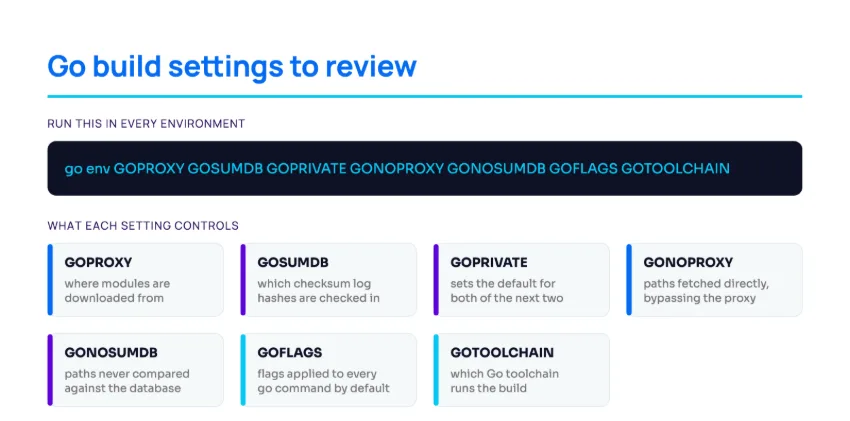
GOSUMDB: Preserve Checksum Verification
The Go checksum database provides an important integrity layer by allowing module hashes to be compared against a public transparency log.
However, teams sometimes disable checksum verification temporarily when dependency resolution creates a release blocker. While this may solve an immediate operational issue, it can also weaken the verification guarantees applied to future builds if the exception remains in place.
A stronger approach is to maintain checksum verification and address availability challenges through mechanisms such as dependency caching or controlled proxy strategies rather than reducing verification coverage.
GOPRIVATE: Keep Private Module Exceptions Explicit
Private modules require different handling because they may not be available through public module infrastructure. Go provides GOPRIVATE to identify these paths, but the scope of these exceptions matters.
A narrowly defined configuration:
GOPRIVATE=github.com/company/* creates a clear boundary around private dependencies.
A broad configuration:
GOPRIVATE=*may unintentionally apply private-module behavior to dependencies that were not intended to bypass public verification mechanisms.
Security exceptions should be explicit and limited to the components that require them.
GOPROXY: The Dependency Supply Path
Many organizations run internal Go proxies for build reliability, caching, availability, and visibility into consumed modules.
One distinction matters here: caching modules is not the same as caching hashes. If the proxy doesn't also mirror checksum database records, hash verification still depends on the public checksum database being reachable - the exact availability problem this section is trying to solve stays unsolved.
A controlled proxy can become an important part of software supply chain governance because it provides insight into how dependencies enter an organization's environment. However, the proxy itself becomes part of the dependency trust boundary.
Organizations should understand:
- Which dependencies flow through the proxy
- How modules are cached
- How verification information is preserved
- What controls protect the proxy infrastructure
A proxy can improve operational control, but it does not establish provenance by itself.
GOTOOLCHAIN: Build Infrastructure Is Also Software
Modern Go versions can automatically obtain toolchains based on configuration in:
- go.mod
- go.work
- GOTOOLCHAIN
This means the compiler and build tooling become another software dependency entering the development environment.
The same supply chain principles that apply to application dependencies also apply to the tools used to create applications.
5.Managing Dependencies and Evaluating Risk
Vendoring: More Control, Different Tradeoffs
Vendoring copies dependencies into the application repository:
go mod vendor
This gives teams additional control because dependencies can be reviewed alongside application code, builds can run without external network access, and dependency updates become explicit repository changes.
However, vendoring does not establish provenance.
It answers - "Which dependencies did we choose to include?"
It does not answer - "Where did those dependencies originate, and how were they created?"
Vendoring changes when dependency review happens, but it does not replace the need for evidence about software origin and creation.
Vulnerability Analysis: A Separate Security Layer
Dependency integrity and vulnerability analysis address different security questions.
A dependency can be correctly verified but still contain a known vulnerability. Similarly, a dependency can have no known vulnerabilities but lack evidence about its origin or creation process.
Tools must therefore be evaluated based on the question they answer.
Go's govulncheck adds an important capability by using reachability analysis rather than only identifying vulnerable dependency versions. It helps determine whether vulnerable code paths are actually used by an application.
This complements integrity verification:
- go.sum helps determine whether dependency content changed.
- Vulnerability analysis helps determine whether known weaknesses affect application behavior.
Together, they provide stronger dependency security coverage.
A secure Go software supply chain requires more than enabling checksum verification. Organizations also need consistent build configurations, controlled dependency entry points, and evidence that supports decisions about the software they consume.
6. Moving From Software Consumption to Software Verification
Modern software is assembled from an increasingly complex network of external components. Open source libraries, container images, build tools, and third-party dependencies allow engineering teams to accelerate development, but they also extend the software supply chain beyond the boundaries of direct organizational control.
This creates a fundamental challenge: organizations are responsible for securing software components they did not build themselves.
Traditional security practices address important parts of this challenge.
Organizations increasingly need confidence before software components become part of production environments.
This requires moving beyond questions such as:
- What component are we using?
- Does it contain known vulnerabilities?
- Has it changed since publication?
toward deeper questions:
- Does this component correspond to its claimed source?
- How was it created?
- What evidence supports trusting it?
This represents the shift from software consumption to software verification.
Vulnerability scanners identify known risks. SBOMs (software bills of materials, an inventory of an application's components) provide visibility into composition. Integrity mechanisms like Go's checksum model detect unexpected changes.
However, these controls answer different questions. Knowing what software exists, whether it contains known vulnerabilities, or whether it has changed does not always provide enough evidence to determine whether the software should be trusted.
Modern software supply chains require a stronger foundation: verified software components supported by evidence.
What Verified Software Components Provide
A verified software component is not defined only by its name, version, or vulnerability status. It includes evidence connecting the component to its origin, creation process, and security evaluation.
Area | What organizations need to understand |
Origin | Where the component came from and whether it matches its claimed source |
Creation | How the software was produced and what evidence exists about the process |
Integrity | Whether the artifact being consumed matches the artifact that was verified |
Security posture | What is known about vulnerabilities, dependencies, and policy requirements |
This evidence allows organizations to make software trust decisions based on verification rather than assumptions.
Libraries and container images represent two critical software entry points where organizations need stronger evidence before software becomes part of production environments. That's a related but separate problem, covered briefly below.
7. CleanStart and Verified Software Artifacts
CleanStart applies this verification model to the software components that form modern applications, including both libraries developers consume and container images organizations deploy.
The principle is simple: Verification builds trust. Instead of relying only on assumptions about software origin, security posture, or release processes, organizations can use evidence-backed software artifacts to make more informed trust decisions.
Verified Libraries
Open-source libraries are essential building blocks of modern applications, but manually evaluating every dependency does not scale as application complexity grows.
A verified library approach adds an evidence layer around the components entering the software supply chain, helping teams understand:
- The origin of the dependency
- Relevant provenance information
- Security characteristics
- Verification status
The goal is not to replace existing dependency management or security practices. Verification complements these processes by providing stronger evidence for software adoption decisions.
Verified Container Images
Container images represent another critical software supply chain entry point.
Because containers package application dependencies and runtime components together, the security posture of the image foundation directly affects workloads running in production.
Verified container images help organizations establish stronger software foundations through capabilities such as:
- Software provenance
- SBOM visibility
- Cryptographic verification
By establishing confidence earlier in the software lifecycle, organizations can reduce the effort required to identify and remediate software risks later.
8. Building Software Supply Chain Posture Through Verification
Verified components are one part of a broader software supply chain strategy.
A strong software supply chain posture requires both visibility into software components and evidence about those components. Visibility helps organizations understand what software components exist, while verification helps determine what evidence supports trusting those components.
As organizations adopt open source at scale, cloud-native architectures, third-party software, and AI-assisted development workflows, the number of software trust decisions continues to increase.
Security teams cannot rely only on manual review or after-the-fact remediation. They need evidence that scales with software velocity.
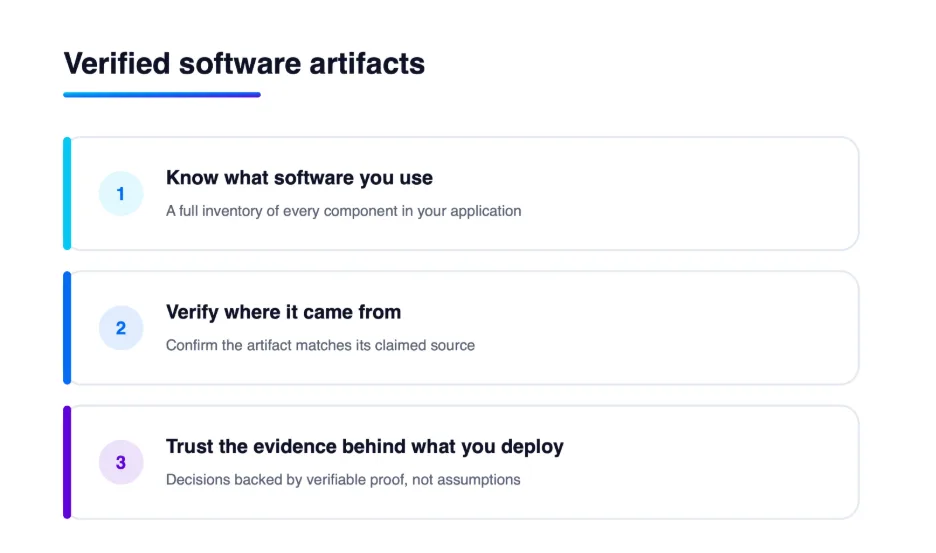
The Role of Evidence in Software Trust
A strong software supply chain posture requires evidence across the lifecycle:
Area | Evidence Required |
Discovery | Understanding what software components exist |
Integrity | Confirming software has not changed unexpectedly |
Provenance | Understanding origin and creation history |
Security analysis | Evaluating known risks and behavior |
Governance | Applying policies before software reaches production |
No single control provides the complete picture.
Together, these capabilities help organizations move from software visibility toward software confidence.
Final Takeaway
Go's dependency model demonstrates an important principle:
Strong integrity controls are essential, but integrity alone does not establish software trust.
Modern software supply chains require organizations to combine:
- Software visibility
- Integrity verification
- Provenance evidence
- Security analysis
- Governance controls
The future of software security is not only about finding problems faster.
It is about establishing trust in the software organizations choose to use.
Verification builds trust.