



Encrypted data stolen today could become readable years later, even if the systems protecting it are secure right now. That is the risk driving post-quantum cryptography adoption. With NIST standards finalized and migration timelines emerging across the US, UK, EU, and India, organizations need to understand where their cryptography is exposed. This guide covers quantum-related risks, CBOMs, compliance deadlines, container readiness, and the practical steps required to prepare for quantum-resistant security.
What is Post-Quantum Cryptography?
Post-quantum cryptography (PQC) is public-key cryptography designed to stay secure against an adversary with a cryptographically relevant quantum computer, as well as against classical attack. It replaces the key establishment and digital signature algorithms that Shor’s algorithm would break, which is why RSA and elliptic curve cryptography are in scope and symmetric algorithms such as AES-256 are not.
The National Institute of Standards and Technology (NIST) finalized its first three post-quantum cryptography standards: ML-KEM for establishing shared secret keys and ML-DSA and SLH-DSA for digital signatures.
Why Does Post-Quantum Cryptography Matter Now?
Post-quantum cryptography matters now because attackers can capture encrypted information today and potentially decrypt it once sufficiently powerful quantum computers become available. This threat, known as harvest now, decrypt later (HNDL), puts sensitive information at risk long before quantum attacks become practical. Financial records, healthcare data, intellectual property, and government
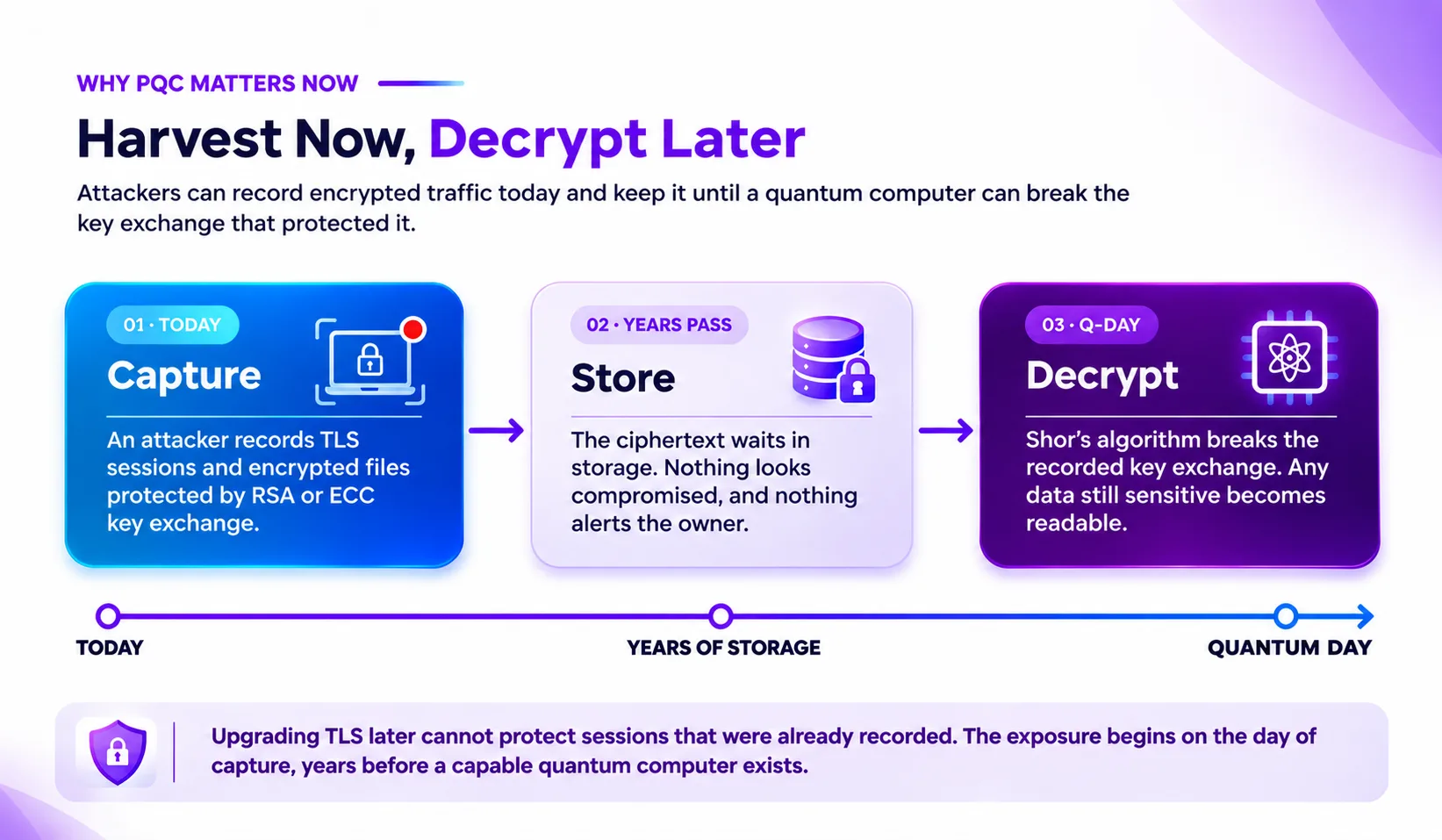
Organizations cannot wait for a confirmed breakthrough date, and in the United States the schedule no longer depends on one. NIST IR 8547, Transition to Post-Quantum Cryptography Standards, was published in final form on 27 October 2026. It deprecates every approved quantum-vulnerable public-key algorithm after 2030, at every security strength, and disallows them under NIST standards and guidelines after 2035
Meeting these timelines requires organizations to first understand where quantum-vulnerable cryptography exists across their systems. Cryptographic algorithms are often embedded in applications, third-party libraries, and infrastructure components, making them difficult to identify and track. This makes cryptographic visibility a critical part of PQC readiness, and a Cryptographic Bill of Materials (CBOM) can help organizations identify their exposure and prepare for the transition to quantum-resistant cryptography.
What Is a Cryptographic Bill of Materials (CBOM)?
Modern software applications rely on multiple cryptographic components to secure data, authenticate users, and protect communications. These components may come from different libraries, frameworks, and third-party dependencies, making it difficult for organizations to maintain a complete picture of the cryptography used across their systems. This becomes particularly important during PQC migration, when organizations need to identify which existing cryptographic implementations may require replacement.
A Cryptographic Bill of Materials is a structured, machine-readable inventory of cryptographic assets used within software applications and systems. It identifies algorithms, keys, certificates, protocols, and their dependencies, helping organizations assess cryptographic risks and identify systems that require post-quantum cryptography migration.
CBOM vs. SBOM: Key Differences
A Software Bill of Materials (SBOM) identifies the components that make up an application, while a CBOM documents the cryptography those components use. Both support security assessments, but they provide different levels of visibility.
Aspect | CBOM | SBOM |
Purpose | Track cryptographic assets and dependencies | Track software components and dependencies |
Inventory includes | Algorithms, keys, certificates, protocols | Libraries, packages, versions, suppliers |
Example | RSA-2048, ECDSA P-256, ML-KEM-768 | OpenSSL, Log4j, software packages |
Security focus | Cryptographic weaknesses and quantum exposure | Known vulnerabilities and software supply chain risks |
PQC migration role | Identifies cryptography requiring assessment or replacement | Locates software components that may contain affected cryptography |
Supported formats | CycloneDX 1.6 and later | CycloneDX, SPDX |
What Information Does a CBOM Record?
A CBOM captures technical attributes needed to evaluate cryptographic strength and migration requirements. The most relevant fields for PQC readiness include:
- Algorithm: The cryptographic algorithm in use, such as RSA, ECDSA, ML-KEM, or ML-DSA.
- Cryptographic primitive: The function performed, such as key encapsulation, digital signatures, hashing, or encryption.
- Parameter set: The specific configuration, such as RSA-2048 or ML-KEM-768, that determines relevant security properties.
- NIST quantum security category: The security-strength category, from 1 to 5, assigned to applicable post-quantum algorithm parameter sets. Traditional algorithms such as RSA do not receive these PQC categories.
Which regulators are asking for CBOMs
Government cybersecurity agencies and quantum-readiness programs are increasingly calling for cryptographic inventories to support PQC migration. Key guidance and timelines include:
- United States: Executive Order 14412, signed 22 June 2026, directs CISA to publish public guidance on the minimum elements of a cryptographic bill of materials within 270 days, which falls around 19 March 2027. The same order directs agencies toward automated cryptographic discovery. Anyone selling into the US federal market should expect CBOM language to follow that guidance into procurement.
- CERT-In, India: Its Technical Guidelines Version 2.0, dated July 9, 2025, recommend maintaining CBOM and QBOM inventories, integrating them with vulnerability management, and keeping cryptographic asset records updated. These are technical guidelines, not a universal statutory CBOM mandate.
- India's National Quantum Mission: The Quantum Safe Ecosystem in India report recommends phased CBOM adoption in procurement. Its foundational milestones include cryptographic asset inventories by 2027 for critical information infrastructure sectors and 2028 for enterprises. These are proposed roadmap targets.
- India, National Quantum Mission: The Report on Quantum-Safe Ecosystem in India: Roadmap to Quantum Resiliency, published May 2026, puts dates on CBOM procurement rather than leaving it as a recommendation. Organizations should begin requesting CBOMs and quantum resiliency roadmaps from vendors in FY 2026-27, and should mandate CBOM submission from vendors through procurement from FY 2027-28. Foundational milestones are 2027 for critical information infrastructure sectors and 2028 for other enterprises. These are roadmap targets set by the mission, and the procurement gate arrives before the first migration milestone
- European Union: The coordinated PQC roadmap calls for initial cryptographic asset management and risk assessment by the end of 2026, with high-risk use cases targeted for migration by 2030. These are recommended transition milestones, not universal legal deadlines for CBOM submission.
What Format Is Used for a CBOM?
CycloneDX 1.6 introduced standardized support for cryptographic assets, allowing CBOMs to be generated and exchanged in machine-readable JSON or XML formats. Its cryptographic asset model includes algorithm properties, parameter set identifiers, NIST quantum security levels, and relationships between cryptographic components.
For example, a CycloneDX CBOM can document an RSA-2048 implementation alongside an ML-KEM-768 implementation, helping security teams distinguish quantum-vulnerable public-key cryptography from standardized post-quantum alternatives.
What Are the PQC Compliance Deadlines and Mandates?
Post-quantum cryptography migration timelines differ across countries and industries. Some impose requirements on government systems, while others establish recommended transition milestones. Organizations should understand which deadlines apply to their systems, suppliers, and regulatory obligations.
- US federal civilian systems: EO 14412 and OMB M-26-15
Executive Order 14412, Securing the Nation Against Advanced Cryptographic Attacks, was signed on 22 June 2026. It requires federal agencies to transition all High Value Assets and high impact systems, excluding National Security Systems, to post-quantum cryptography for key establishment by 31 December 2030, and for digital signatures by 31 December 2031. OMB Memorandum M-26-15, issued 24 June 2026, turned that into a phased migration framework and required agency migration plans within 120 days of issue.
- NSA CNSA 2.0:
The National Security Agency's Commercial National Security Algorithm Suite 2.0 (CNSA 2.0) establishes quantum-resistant cryptographic requirements for U.S. National Security Systems (NSS).
Under CNSSP 15, new NSS acquisitions must support CNSA 2.0 beginning January 1, 2027. Equipment and services that cannot support CNSA 2.0 must generally be phased out by December 31, 2030, and CNSA 2.0 algorithms become mandatory for use by December 31, 2031, subject to applicable exceptions.
These requirements affect NSS operators and relevant technology suppliers, not all commercial businesses.
- NIST IR 8547:
NIST IR 8547, Transition to Post-Quantum Cryptography Standards, published in final form on 27 October 2026, identifies quantum-vulnerable cryptographic standards and sets the schedule for leaving them. The final report deprecates all approved quantum-vulnerable public-key algorithms after 2030, including RSA-3072, P-256 and Ed25519, and disallows them under NIST standards and guidelines after 2035. It works in classical security strength from the 112-bit row upward, so mapping a specific key size onto those dates is an inference rather than a quotation.
IR 8547 is technical transition guidance and imposes nothing on a private business by itself. What reaches private businesses is the instruments that point at it: EO 14412 and M-26-15 for federal systems and their contractors, and FIPS validation, which follows NIST standards.
- EU Coordinated PQC Roadmap
The European Union's June 2025 coordinated PQC roadmap establishes a common transition framework for Member States, prioritizing public administrations, critical infrastructure, and high-risk systems.
The roadmap calls for Member States to begin transitioning by the end of 2026, with high-risk use cases targeted for migration by the end of 2030. These are coordinated policy milestones rather than universal legal deadlines for every EU business.
Organizations must also consider applicable national and sector-specific requirements.
- UK NCSC Migration Timeline
The UK's National Cyber Security Centre (NCSC) recommends a three-phase transition to post-quantum cryptography:
- By 2028: Complete cryptographic discovery, assess dependencies, and develop an initial migration plan.
- By 2031: Complete the highest-priority migrations and refine the remaining transition plan.
- By 2035: Complete migration across systems, services, and products.
These are recommended planning milestones, not universal statutory requirements. Organizations managing critical services or long-lived sensitive information should prioritize systems with the greatest quantum exposure.
- India National Quantum Mission and CERT-In
India's National Quantum Mission (NQM) published its Quantum-Safe Ecosystem in India roadmap in May 2026, proposing phased PQC migration targets for critical infrastructure and other enterprises.
For critical information infrastructure sectors, the proposed milestones are 2027 for foundational readiness, 2028 for high-priority migration, and 2029 for quantum resilience across systems. For other enterprises, the corresponding targets are 2028, 2030, and 2033.
The nearer obligation for suppliers is procurement rather than migration: the roadmap asks organizations to request CBOMs from vendors in FY 2026-27 and to mandate CBOM submission from FY 2027-28. Separately, CERT-In's Technical Guidelines Version 2.0 address cryptographic inventories, including CBOMs and QBOMs. Neither the guidelines nor the NQM targets are statutory PQC migration deadlines for all Indian businesses.
How Does PQC Affect the Software Supply Chain?
Post-quantum cryptography migration requires more than upgrading encryption libraries or TLS configurations. Applications may contain quantum-vulnerable cryptography inherited from language runtimes, third-party packages, Python wheels, and precompiled binaries. Some dependencies bundle their own cryptographic libraries rather than using the system-installed version.
For example, updating OpenSSL on a server may leave a Python wheel with bundled OpenSSL unchanged. Similarly, a statically linked Go binary may continue using an older cryptographic implementation until it is rebuilt. Even one dependency relying on RSA or ECC for a security-critical operation can leave a quantum-vulnerable path in an otherwise upgraded application.
Organizations need to inspect direct and transitive dependencies, identify bundled cryptographic implementations, and verify the algorithms actually used at runtime. A Cryptographic Bill of Materials helps locate these dependencies, while compatibility and runtime testing confirm whether the intended PQC protections are working.
Updating OpenSSL on a server does not automatically replace cryptographic libraries bundled inside application dependencies. CleanStart's hardened container images provide minimal, source-built foundations with SBOMs, signed artifacts, and build provenance. These capabilities help teams identify recorded software components, verify image origins, and maintain updated container foundations while assessing PQC readiness.
How to Assess PQC Readiness in Containers?
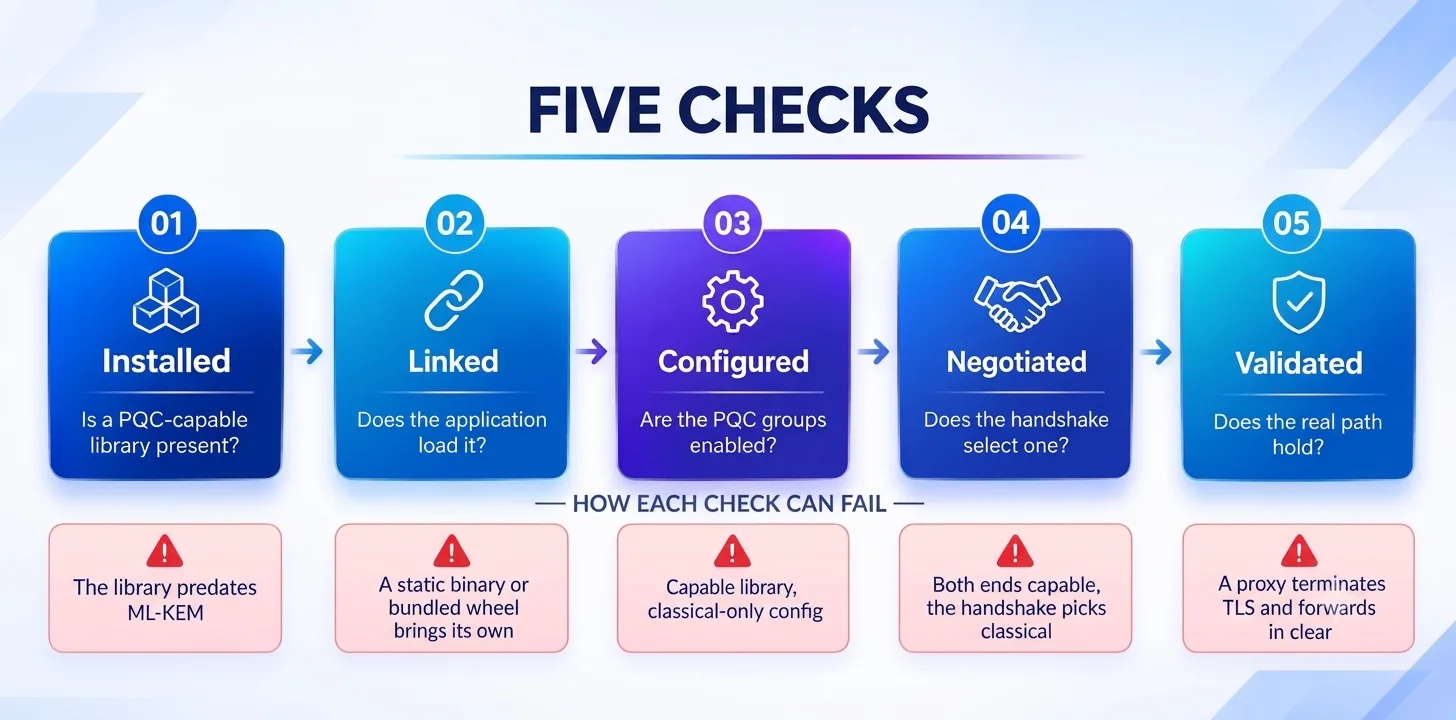
A container image containing OpenSSL 3.5 or another PQC-capable library is not automatically quantum-resistant. The application must use the correct cryptographic implementation, enable supported algorithms, and successfully negotiate them where applicable. Five checks establish its actual readiness:
- Installed: Confirm that the container contains a PQC-capable library, such as OpenSSL 3.5+, with support for ML-KEM, ML-DSA, or other required algorithms.
- Linked: Verify which cryptographic library the application actually uses. A statically linked binary or bundled Python wheel may bypass the container's updated OpenSSL installation.
- Configured: Inspect TLS settings, enabled providers, and supported algorithm groups. PQC-capable libraries may still operate with classical-only configurations.
- Negotiated: Capture the TLS handshake to confirm that compatible endpoints select a hybrid group such as X25519MLKEM768, rather than negotiating classical X25519 alone.
- Validated: Run interoperability tests across the real path, including reverse proxies, load balancers and service meshes, and confirm that peers without hybrid support fail cleanly rather than downgrading silently. Where a validated module is required, check the module against NIST's CMVP list rather than against the package version.
These checks distinguish cryptographic capability from actual use. An image can pass the installation check while failing at application linking, TLS negotiation, or runtime validation.
How Can Organizations Prepare for PQC Migration?
A practical PQC migration should move from identifying cryptographic exposure to deploying and maintaining quantum-resistant protections. These five steps focus on implementation decisions, testing, and long-term maintainability.
Step 1: Build a Cryptographic Inventory
Generate a CBOM using a format such as CycloneDX 1.6 and map each cryptographic implementation to its application, service owner, and deployment environment. Record where cryptography is used, including TLS termination points, certificate signing, and service-to-service communication. Flag assets whose cryptographic dependencies cannot be identified.
Step 2: Prioritize by Data Confidentiality Requirements
Compare each system's required confidentiality period against its estimated migration time. For example, encrypted medical records requiring 20 years of confidentiality deserve earlier attention than short-lived operational data. Rank exposed systems using data sensitivity, external accessibility, and the time needed to replace incompatible components.
Step 3: Enable Hybrid Key Exchange
Start with a controlled TLS 1.3 deployment using a supported hybrid group such as X25519MLKEM768. Enable it on compatible clients and servers, then test handshake size, latency, connection failures, and intermediary compatibility. Roll out gradually rather than changing every production endpoint simultaneously.
Step 4: Verify What Is Actually Negotiated
Use TLS handshake inspection or compatible diagnostic tools to verify the selected key exchange group for each connection path. Test direct connections and those passing through reverse proxies, load balancers, or service meshes. Track classical-only negotiations separately so successful TLS connections are not automatically counted as PQC-protected.
Step 5: Design for Crypto Agility
Move algorithm selection into centrally managed configurations instead of embedding it in application code. Maintain versioned cryptographic policies, automated compatibility tests, and a rollback procedure. Ensure libraries and certificate-handling components can be upgraded independently where feasible, allowing future algorithm changes without rebuilding the entire application architecture.
What Does PQC Readiness Not Solve?
Deploying quantum-resistant algorithms does not guarantee that an application, container, or communication channel is secure. Several risks remain outside the scope of PQC migration:
- Vulnerable application dependencies: Replacing RSA-based key establishment with ML-KEM does not patch exploitable CVEs in OpenSSL, application frameworks, or container packages.
- Compromised signing infrastructure: ML-DSA cannot prevent unauthorized software releases if attackers steal signing keys or gain access to the signing pipeline.
- Unprotected communication paths: A PQC-enabled TLS connection does not secure traffic after TLS termination if a proxy forwards it over an unprotected internal connection.
- Implementation weaknesses: ML-KEM and ML-DSA implementations can still contain side-channel vulnerabilities, faulty randomness, or incorrect parameter handling.
- Previously harvested traffic: Upgrading TLS today cannot retroactively protect past sessions whose encrypted traffic and vulnerable key exchanges were already captured.
PQC readiness establishes resistance to specific quantum cryptographic attacks. It does not establish application security, software integrity, or protection across every communication path.
How Does CleanStart Support PQC Readiness?
A container may include updated cryptographic libraries while still carrying vulnerable components through its base image or application dependencies. CleanStart helps teams address these software supply chain risks through hardened container images, verifiable build records, and continuous vulnerability visibility.
CleanStart supports PQC readiness in four practical ways:
- Post-quantum algorithms in the image: our images ship OpenSSL 3.6.5 with ML-KEM for key establishment and ML-DSA and SLH-DSA for signatures, in both the standard image and one running in FIPS mode.
- Inside the FIPS provider, not beside it: in the FIPS-mode image the post-quantum algorithms come from the FIPS module itself rather than from a second implementation sitting alongside it. That is the distinction check 2 exists to catch, and it is the one a package list cannot see.
- Hybrid key exchange that actually negotiates: both images negotiate X25519MLKEM768 by default against public endpoints, and the FIPS image also offers SecP256r1MLKEM768, SecP384r1MLKEM1024 and MLKEM1024. Check 4 confirms it rather than assuming it.
- Conformance we checked rather than assumed: we cross-checked the implementation against three independent implementations of FIPS 203, 204 and 205, passing public keys, ciphertexts and signatures in both directions and confirming the input checks the standards require.
Learn how CleanStart can prepare you for post-quantum cryptography.
Book a Demo!