



Shipping software should not feel risky. This article explains CI/CD and how continuous integration, delivery, and deployment improve release speed, reliability, and quality. It covers CI/CD pipelines, example workflows, key tools, testing, security, cloud best practices, and how CI/CD connects to DevOps and platform engineering.
What is CI CD?
CI CD is a set of practices and tooling in software development that automate how code changes move from a code repository to a running application, including how a container packages the app and its runtime dependencies into a portable unit that can be deployed consistently. In a typical DevOps workflow, a developer commits or merges changes into a repository (for example on GitHub or GitLab), a pipeline runs an automated build and validation process, and the system then releases or deploys the result through a controlled deployment process, often by publishing a container image and rolling that container into the target environment.
CI (continuous integration) means development teams frequently integrate code changes into a shared branch and validate them automatically. The CI part focuses on fast feedback by running tasks such as compilation, linting, automated testing, and integration tests whenever changes are pushed or a pull request is created. This reduces breakages caused by late or infrequent merges in the development process.
CD most commonly refers to continuous delivery and sometimes to continuous deployment. Continuous delivery means the pipeline produces a release-ready build and can promote it toward the production environment with approvals or release gates. Continuous deployment goes one step further by automatically pushing every passing change to production, making deployment a fully automated outcome of the pipeline.
What is CI CD integration?
CI CD integration is the practice of connecting your continuous integration and continuous delivery workflow to the systems that create, validate, secure, and release software so the pipeline can run with consistent automation from code change to deployment.
Example: a pull request triggers GitHub Actions, runs continuous testing, builds an artifact, runs DevSecOps checks, and then enforces container security by scanning the container image for known vulnerabilities and policy violations before deploying the approved release to a Kubernetes cluster running on AWS, so delivery becomes repeatable and measurable across environments.
Build and ship on trusted, ready-to-run
Cleanstart Images Today!What is CI CD in DevOps?
CI CD in DevOps is the delivery model where development work moves through an automated pipeline so code can be built, tested, and released in a repeatable way, often using containerization to package the application and its dependencies into a consistent deployable unit across environments, with shared ownership between development teams and the operations team. In DevOps, CI CD turns software delivery into an operational workflow rather than a one time handoff, so releases are frequent, controlled, and easier to support in production because the same containerized build can be promoted from testing to production without environment drift.
CI (continuous integration) is the DevOps practice of integrating code into a shared branch frequently and validating every change automatically. CD (continuous delivery or continuous deployment) extends that workflow so validated builds can be promoted and deployed through consistent release steps.
What is a CI CD pipeline?
A CI CD pipeline is an automated workflow that takes a code change and moves it through repeatable stages so it can be built, tested, and released with minimal manual work. It is the execution path of CI (continuous integration) and CD (continuous delivery or continuous deployment) and it standardizes how software is validated and promoted across environments.
Teams often implement pipelines using tools like Jenkins, which orchestrates the stages, stores run history, and integrates with build and deployment systems, including container runners that rely on cgroups to enforce CPU and memory limits so build and test jobs stay isolated and predictable. When pipelines are reliable, they improve productivity by shortening feedback loops, reducing manual release steps, and making deployments repeatable.
What are the stages of a CI CD pipeline?
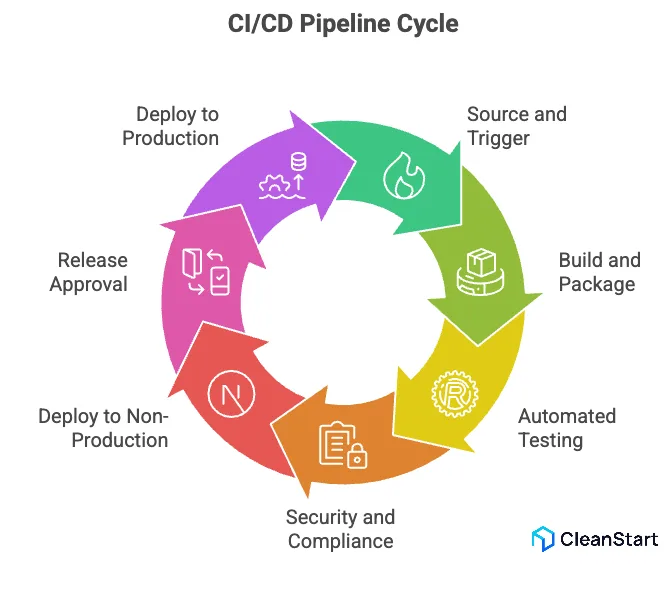
Here are the stages of a CI CD pipeline:
- Source and trigger stage: A pipeline detects changes to code in the source code repository and pulls new code from a commit so the run starts from a known version. This stage anchors the ci process in the development cycle.
- Build and package stage: The pipeline compiles, packages, and creates an artifact that can be promoted across environments. This stage standardizes development and deployment so software teams release the same build that passed validation.
- Automated testing stage: The pipeline runs automatic testing to verify behavior early in the software development process, and it uses a Dockerfile to define the build steps and runtime environment so the same dependencies and tools are used in every test run. This stage protects software quality by catching regressions before release.
- Security and compliance stage: The pipeline runs checks for security and compliance to identify security issues before deployment. This stage improves security by enforcing policies as part of DevOps automation, not as a late manual review.
- Deploy to non production stage: The pipeline deploys to a test or staging environment as part of development and deployment. This stage validates deployment mechanics and environment fit before production.
- Release approval and promotion stage: The pipeline applies controls that decide whether a build can move forward. This stage enables reliable software delivery when teams require review gates or change management.
- Deploy to production stage: The pipeline can deploy to production automatically or after approval, depending on the organization’s practices of continuous integration and release governance. This stage completes development and operations teams ownership of reliable software delivery.
Tools such as Travis CI can run these stages as one pipeline, helping devops teams achieve faster and more reliable software when the stages are consistently enforced.
Why is CI CD important?
CI CD is important because it makes software delivery predictable, repeatable, and faster across the software development lifecycle. It replaces ad hoc releases with a controlled delivery pipeline that validates every change and standardizes testing and deployment, including verifying the container entrypoint that defines the exact command the container runs at startup, which reduces runtime surprises in production.
CI CD also improves release reliability. A delivery pipeline that builds and validates the same artifact across environments reduces “works on my machine” failures and supports reliable software releases.
Overall, CI CD fits into the DevOps model by aligning integrated development with operations readiness, so teams can get new code to users faster without sacrificing control over testing and deployment.
What are common CI CD tools?
CI CD tools are as follows:
- Jenkins
- GitHub Actions
- GitLab CI/CD
- Azure Pipelines
- AWS CodePipeline and AWS CodeBuild
- CircleCI
- Travis CI
- Bitbucket Pipelines
- TeamCity
- Bamboo
- GoCD
These tools orchestrate each stage in the pipeline, enable automated CI, and support continuous integration and continuous deployment patterns, including workflows that can commit into production when configured to deploy automatically.
Want a CI CD workflow tailored to your stack?
Book a demo now!What is CI CD security?
CI CD security embeds security throughout the software development workflow by securing each stage that interacts with container orchestration, where platforms like Kubernetes schedule, network, and scale containers, and those controls must be validated and enforced in the pipeline by securing:
CI CD security embeds security throughout the software development workflow by securing:
- Code and dependencies checked at build time before artifacts are created
- Build and release integrity so the produced artifact matches the reviewed source and cannot be tampered with
- Secrets and credentials so tokens, keys, and environment access are not exposed through pipeline logs or misconfiguration
- Deployment permissions and approvals so only authorized changes reach sensitive environments
- Auditability so every pipeline action is traceable to a change, actor, and build output
What are best practices for cloud systems in CI CD?
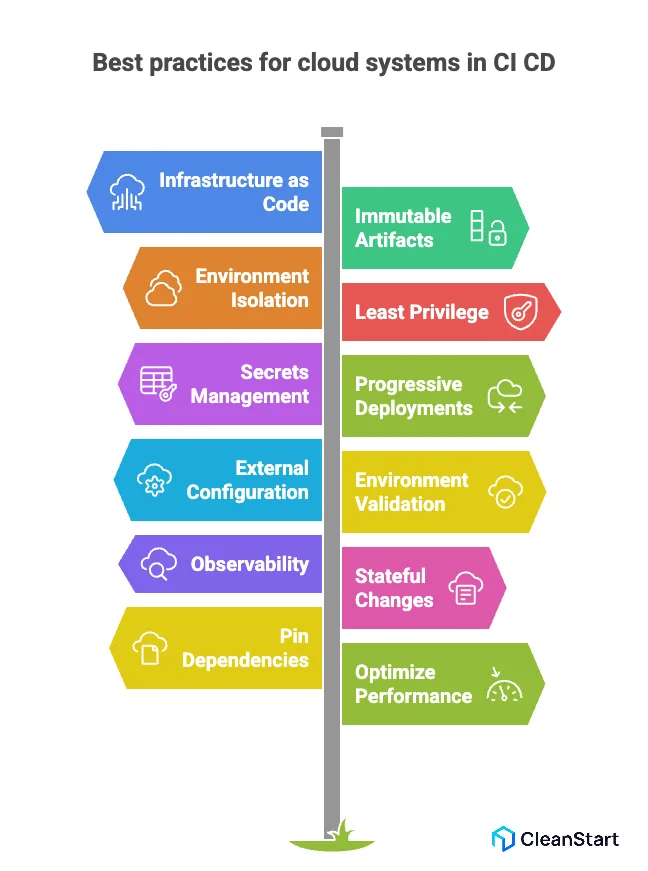
For cloud systems in CI CD, the best practices are:
- Use infrastructure as code for every environment so provisioning is versioned, reviewable, and reproducible.
- Promote the same immutable artifact across environments so staging and production run identical build outputs, and validate the container runtime that executes the container process so the same runtime behavior, isolation, and resource handling apply in every environment.
- Separate environments with strong isolation using separate cloud accounts or projects, distinct networks, and separate credentials.
- Apply least privilege to pipeline identities so the CI CD runner can deploy only what it must, and only to its target environment.
- Use a dedicated secrets manager and inject secrets at runtime; never store secrets in source control or pipeline logs.
- Make deployments progressive and reversible using blue green or canary releases plus fast rollback to the last known good version.
- Treat configuration as code and keep runtime configuration external to the artifact so environment differences are explicit and controlled.
- Run environment specific validation in the pipeline including smoke checks after deploy, so cloud only failures are caught before users are affected.
- Standardize observability as a deployment requirement so logs, metrics, and traces are available immediately after release for rapid triage.
- Control stateful changes with disciplined migrations so database or queue schema changes are forward compatible and safely rolled back when required.
- Pin and verify base images and dependencies so builds are deterministic and supply chain drift does not change production behavior unexpectedly.
- Optimize pipeline performance without changing outcomes using caching and parallel execution only where results remain reproducible and auditable.
What is CI CD in testing?
CI CD in testing is the practice of running automated tests as part of the CI CD pipeline so every code change is validated before it is released. In the CI stage, tests provide fast, repeatable feedback immediately after a commit or merge, preventing defects from moving deeper into the delivery workflow. In the CD stage, testing verifies that the same build behaves correctly in environments closer to production, reducing release risk.
In practical terms, CI CD testing typically includes:
- Pre merge validation to ensure a change is testable and does not break the main branch.
- Build time tests such as unit tests that confirm core logic and prevent regressions.
- Integration testing to validate how services, APIs, databases, and external dependencies work together, including pulling the exact build from a container registry that stores and versions container images so the test environment runs the same image that will be deployed.
- End to end or acceptance testing in a staging like environment to confirm user critical flows.
- Post deployment smoke tests to confirm the deployment is healthy immediately after release.
The outcome is measurable: tests become a release gate, and only changes that pass the defined test suite progress to delivery or deployment.
How do CI CD, DevOps, and platform engineering relate?
CI CD, DevOps, and platform engineering relate as three layers of the same delivery system, where each layer solves a different problem and reinforces the others.
- CI CD is the execution mechanism. CI CD is the automated workflow that builds, tests, and releases code changes through a pipeline, producing repeatable delivery outcomes (build artifacts, test evidence, deployments).
- DevOps is the operating model around that mechanism. DevOps aligns development and operations work so teams share responsibility for delivery, reliability, and feedback loops. In this model, CI CD becomes the standard way teams ship changes safely and consistently.
- Platform engineering is the productized enablement layer. Platform engineering builds and maintains an internal developer platform (self-service pipelines, standardized environments, golden paths, reusable templates, policy controls) so product teams can use CI CD and DevOps practices without rebuilding delivery infrastructure per team.
In practice, DevOps defines shared accountability and collaboration, CI CD implements the automated delivery workflow, and platform engineering provides the standardized platform that makes CI CD scalable across many teams while reducing cognitive load and variation, including generating an SBOM that inventories the components and dependencies in each build so teams can track what is shipped and assess supply chain risk.
What is the business impact of CI CD?
The following points are related to the business impact of CI CD.
- Faster time to market: Shorter lead time from code change to customer facing release, enabling quicker feature delivery and faster iteration.
- More predictable releases: Standardized pipelines reduce release variability, making delivery schedules and outcomes more dependable.
- Higher release quality: Automated test gates and consistent build steps reduce defect escape into production and reduce rework.
- Lower downtime risk: Smaller, more frequent changes are easier to validate and roll back, which reduces the blast radius of failures.
- Higher team productivity: Automation removes repetitive manual release steps, freeing engineering time for product work instead of release coordination.
- Better cost control: Fewer emergency fixes, fewer release related incidents, and less manual effort reduce the total cost of delivery and support.
- Stronger auditability and governance: Pipeline logs, approvals, and change traceability simplify compliance evidence and internal controls.
- Improved customer experience: Faster fixes and more stable releases reduce service disruption and increase trust in the product.